
What Is Cryptosporidium in Pools and How to Treat It?


If you are concerned about cryptosporidium in your pool, you are not alone. Cryptosporidium, a microscopic parasite, is gaining the attention of pool owners in Australia, with outbreaks on the rise.
Cryptosporidium is a leading cause of health issues like diarrhea, vomiting, and stomach cramps, with higher risks in children and people with weak immune systems.
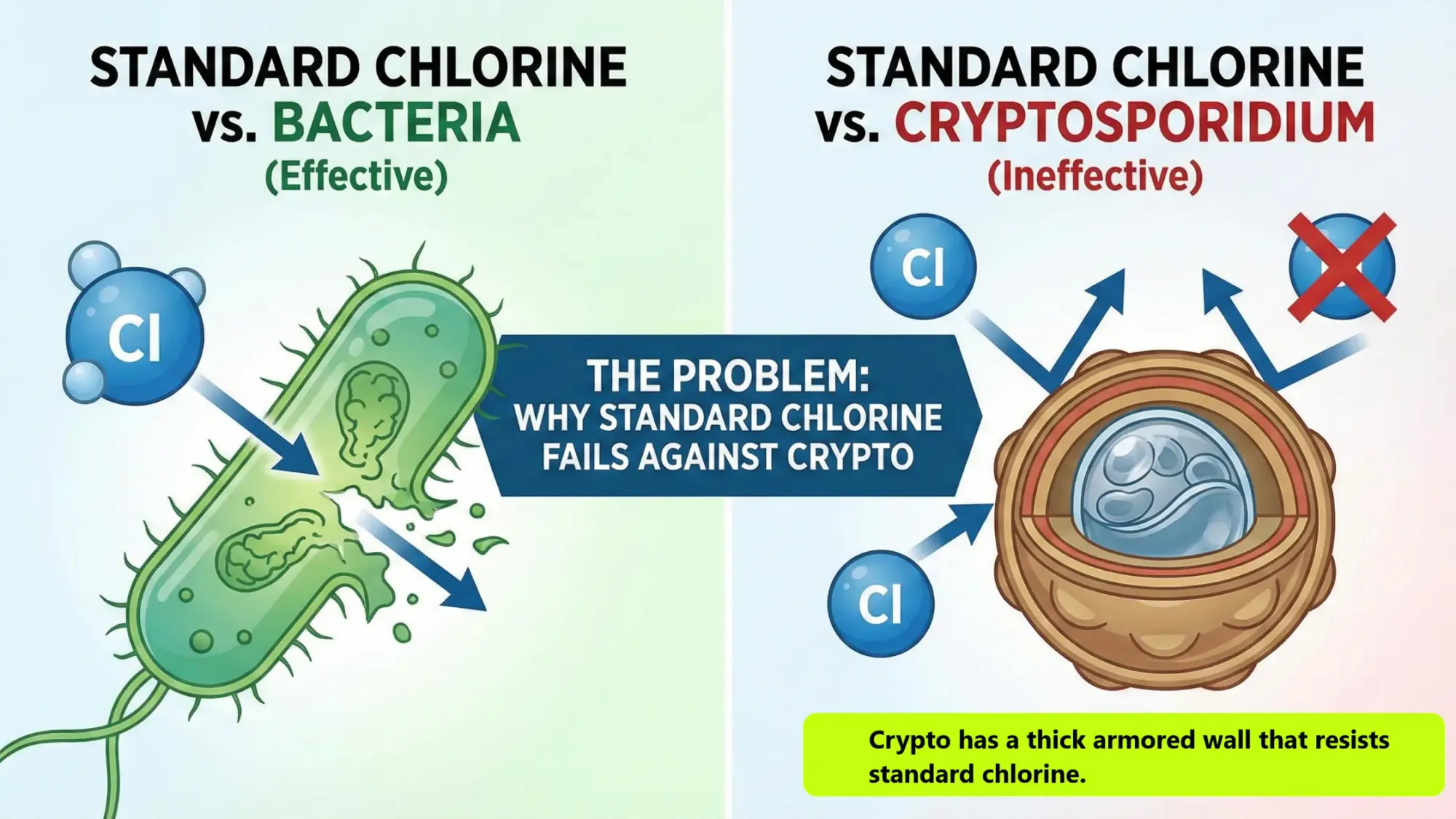
Unfortunately, cryptosporidium is not what you can treat with just chlorine application.
Hence, if you are concerned about cryptosporidium in your pool, you want to know how best to treat it and make your pool safe for you, your family, and public users.
This guide explains what cryptosporidium is and provides a step-by-step instruction on how to treat it:
What is Cryptosporidium?
Cryptosporidium is a tiny parasitic protozoan that causes cryptosporidiosis, an infectious disease. This organism, with a diameter of less than 6 micrometres, lives in water and is hard to deal with.
While many water-based bacteria and viruses are treated with chlorine application, this organism can survive standard chlorination. This survivor trait is credited to the organism’s thick-walled spores that protect it against regular disinfectants.
Cryptosporidium is caused when contamination finds its way into the pool, commonly through the faeces of affected humans or animals. When an affected person’s stool drops in a pool, the pool becomes contaminated with billions of cryptosporidium oocysts. Unfortunately, Crypto only needs about 10 oocysts to infect another person who uses the pool.
Anyone who has contracted Crypto starts to experience symptoms like watery diarrhea, nausea, and fever after two days. These symptoms can last up to two weeks in healthy people, while vulnerable people can experience them for a longer time.
Cryptosporidium, commonly shortened as Crypto, is now a matter of urgent attention in Australia, as outbreaks are now increasing. For example, Queensland records show that 6,178 cases of the micro-organism were recorded in 2024, while Victoria witnessed a 233% increase in 2024 against 2023 data.
It is worth noting that cryptosporidium in pools is blamed on the owners’ low maintenance routines. With proper hygiene routines, you can reduce the risk of cryptosporidium in your pool.
How to Treat Cryptosporidium in Pools
Here are some treatment tips to tackle Crypto in pools, according to the treatment guide from NSW Health. However, while this is what you can do on your own, consult a pool expert to do the job for you if you are not skilled at handling chemicals.
Close the Pool
Once you have the first sign of your pool being contaminated, restrict users from using it, as you don’t want the infection to spread to other users. If your pool shares a filtration system with other pools, you want to close the other pools too to prevent cross-contamination.
Apply Hyper-Chlorination
Although standard chlorination is incapable of killing cryptosporidium, hyper-chlorination is an effective treatment option to remove the presence of cryptosporidium in your pool. Hyper-chlorination is effective since it can break the oocyst’s defences, thanks to high chlorine concentration.
Lower pH to 7.5: NSW Health advises reducing the pH level of your pool to 7.5 or less for enhanced chlorination results.
Increase the water’s free chlorine concentration: Dose the water for a free chlorine CT (the product of chlorine concentration and contact time) value of 15,300 mg.min/L for a pool without stabilisers. With this, you can expect hyper-chlorination to kill all the parasites in your pool.
However, if you own an outdoor pool with a stabiliser, your pool requires a higher CT value of 31,500 mg.min/L instead. This is necessary since chlorine stabilisers slow down the rate at which chlorine kills Crypto.
You can measure your pool’s free chlorine levels with a reliable test kit. NSW Health requires a minimum CT of 15,300. The table below provides a safe buffer aiming for 15,600.
Here's a table explanation that combines the necessary metrics:
| Pool Type | Free Chlorine Concentration (mg/L) | Contact Time (Hours) | CT Value (mg·min/L) |
|---|---|---|---|
| Non-stabilised | 20 | 13 | 15,600 |
| Non-stabilised | 10 | 26 | 15,600 |
| Stabilised | 20 | 28 | 33,600 |
Note: For pools with high stabiliser levels (>50 ppm), NSW Health recommends partially or fully draining the pool before treatment, as chlorine is less effective.
These durations are necessary for high efficacy of the chlorine levels. You also want to ensure good water circulation for even distribution of the chemical.
Filtration and Backwashing
Now that you have killed the oocysts, it is time to filter them out. This is where your filtration system comes in. Since cryptosporidium oocysts are small, ensure your cartridge, sand, or DE filters are in excellent condition.
Once the filtration phase is completed, backwash the filter or remove the media or cartridge to flush out contaminants and prevent recontamination of your pool.
However, your job is not completed. You need to balance the water chemistry before your pool can be safe to use. Reduce the free chlorine level to below 10 mg/L and retest the pH.
Once this is done, your pool is safe to use, and you can reopen it for swimmers.
Prevention Tips
Treating cryptosporidium is a reactive measure, which is not enough. Preventing cryptosporidium occurrences is a better measure to protect the health of your family or public pool users.
The good news is you can reduce the risk of Crypto outbreaks with good pool maintenance habits. Here are a few tips to limit the risk of cryptosporidium in your pool:
Set Hygiene Rules
Set a standard for swimmers to shower thoroughly before entering the pool. Removing lotions and sweat that can harbour parasites is a great place to start your pool maintenance. You also want to encourage kids to use the toilet before coming close to the pool to avoid accidental faeces in the pool.
NSW Health also advises keeping patients with diarrhea away from the pool for at least two weeks after symptoms. This is to prevent them from infesting your pool with cryptosporidium.
Maintain Good Water Chemistry
Regularly test the water level and balance it when necessary. Although this won’t kill cryptosporidium oocysts, keeping a free chlorine level of 1-3mg/L daily is ideal to keep your pool safe for use.
Remove Debris
Debris and leaves are potential hiding places for parasites. Hence, it makes sense to remove them regularly. While you can remove debris from your pool on your own, investing in professional debris cleaners, like Aiper Scuba X1 Pro Max, gives a better result.
FAQ
Can I Swim if I Have Crypto?
No, you can’t swim if you have cryptosporidium. If you have been diagnosed with crypto, wait at least two weeks after symptoms fully stop before using a pool. Using a pool while treating cryptosporidium spreads the oocysts to other swimmers, which you don’t want.
How Long Does Hyper-Chlorination Take?
How long hyper-chlorination takes depends on your choice of chlorine concentration, which is determined by your pool. If you own a standard non-stabilised pool, wait for at least 13 hours at 20 mg/L and 26 hours at 10 mg/L to achieve the required CT value. However, with preparation and post-treatment time factored in, plan to close your pool for a day or two.
Is My Pool Filter Enough to Remove Crypto?
Your filtering system alone is not enough to remove cryptosporidium from your pool. You need hyper-chlorination to kill the parasite, while a good filtering system designed for fine particles can remove the dead oocysts.
Conclusion
Treating a crypto-infested pool can be overwhelming, especially for owners facing the challenge for the first time. However, with the understanding of the parasite’s nature, you can easily remove the presence of cryptosporidium from your pool and make it safe to use.
With increasing numbers of outbreaks across Australia, it makes sense to take proactive steps to protect your family and other users. Set hygiene rules, test your water regularly, and remove debris.
Finally, don’t hesitate to treat cryptosporidium as soon as you have the first sign of an outbreak in your pool.