
What Is the Langelier Saturation Index (LSI) & How to Calculate It?

Clear water does not always mean healthy water. Many Australian pool owners are surprised to learn that water can look sparkling blue while quietly damaging equipment beneath the surface. What is the Langelier Saturation Index? It is the master variable most people overlook. While chlorine and pH usually get all the attention, the true measure of pool water balance depends on the LSI.
This guide breaks down the concept in simple terms, explains why it matters so much for Australian pools, and provides an easy cheat sheet so you can calculate the number yourself. You do not need to be a chemist. With the LSI calculator steps below, you will be able to keep your water stable, protect your investment, and help your Aiper cleaner perform at its best.
What Is the Langelier Saturation Index (LSI)?
The Langelier Saturation Index is a mathematical tool used to check whether pool water is balanced, corrosive, or scale-forming. In simple terms, LSI predicts whether the water will eat away at surfaces or deposit calcium. It was developed by Dr. Wilfred Langelier to assess corrosion in steel pipes, but it has become the gold standard for modern pool care.
The "Goldilocks" Zone (The Range):
LSI works on a simple scale.
- -0.3 to +0.3: Balanced
- Below -0.3: Corrosive
- Above +0.3: Scale forming
Why LSI Matters for Australian Pools
Australia’s high UV index, warm climate, and the popularity of saltwater systems make LSI management especially important. Think of water balance as a seesaw. Even if your pH stays the same, a change in temperature or calcium hardness can shift the LSI.
Corrosive water attacks pump components, metal housings, heater internals, and even delicate parts inside robotic cleaners. On the other hand, scale-forming water can clog filters, leave calcium on tiles, and create rough surfaces on fibreglass or plaster pools. Keeping the LSI within the ideal range is one of the simplest ways to protect both your pool shell and your Aiper robot.
The Components of LSI (The Factors)
Before the LSI formula is used, you need five key readings. These values tell you whether the water is corrosive or scale-forming.
- pH: Measures acidity or basicity. It is the strongest factor in the LSI.
- Water Temperature (TF): Warm water tends to scale. Cold water becomes aggressive and corrosive.
- Calcium Hardness (CF): The amount of dissolved calcium in the pool.
- Total Alkalinity (AF): Determines how resistant the water is to pH swings.
- Total Dissolved Solids (TDS): Everything dissolved in the water, including salt, minerals, and metals.
How Is LSI Calculated? (The Formula & Chart)
To keep the math readable, here is the LSI formula in plain text.
The LSI Formula
(pH + TF + CF + AF) - TDS Constant = LSI
You use your actual pH, but temperature, calcium hardness, and alkalinity must be converted into factor numbers using the chart below.
The LSI Factor Lookup Chart (The Cheat Sheet)
| Value (Reading) | Factor (To use in math) |
|---|---|
| Temperature (TF) | |
| 19°C | 0.4 |
| 24°C | 0.5 |
| 29°C | 0.6 |
| 34°C | 0.7 |
| Calcium Hardness (CF) | |
| 150 ppm | 1.8 |
| 200 ppm | 1.9 |
| 300 ppm | 2.1 |
| 400 ppm | 2.2 |
| Alkalinity (AF) | |
| 80 ppm | 1.9 |
| 100 ppm | 2.0 |
| 120 ppm | 2.1 |
| 150 ppm | 2.2 |
TDS Constant Note:
Use this rule:
- If TDS is less than 1,000 ppm, subtract 12.1
- If TDS is greater than 1,000 ppm, subtract 12.2
Step-by-Step Calculation Example
Here is a realistic Australian situation.
- pH: 7.6
- Temperature: 24°C (Factor 0.5)
- Calcium Hardness: 300 ppm (Factor 2.1)
- Alkalinity: 100 ppm (Factor 2.0)
- TDS: 4000 ppm (Salt pool, Constant 12.2)
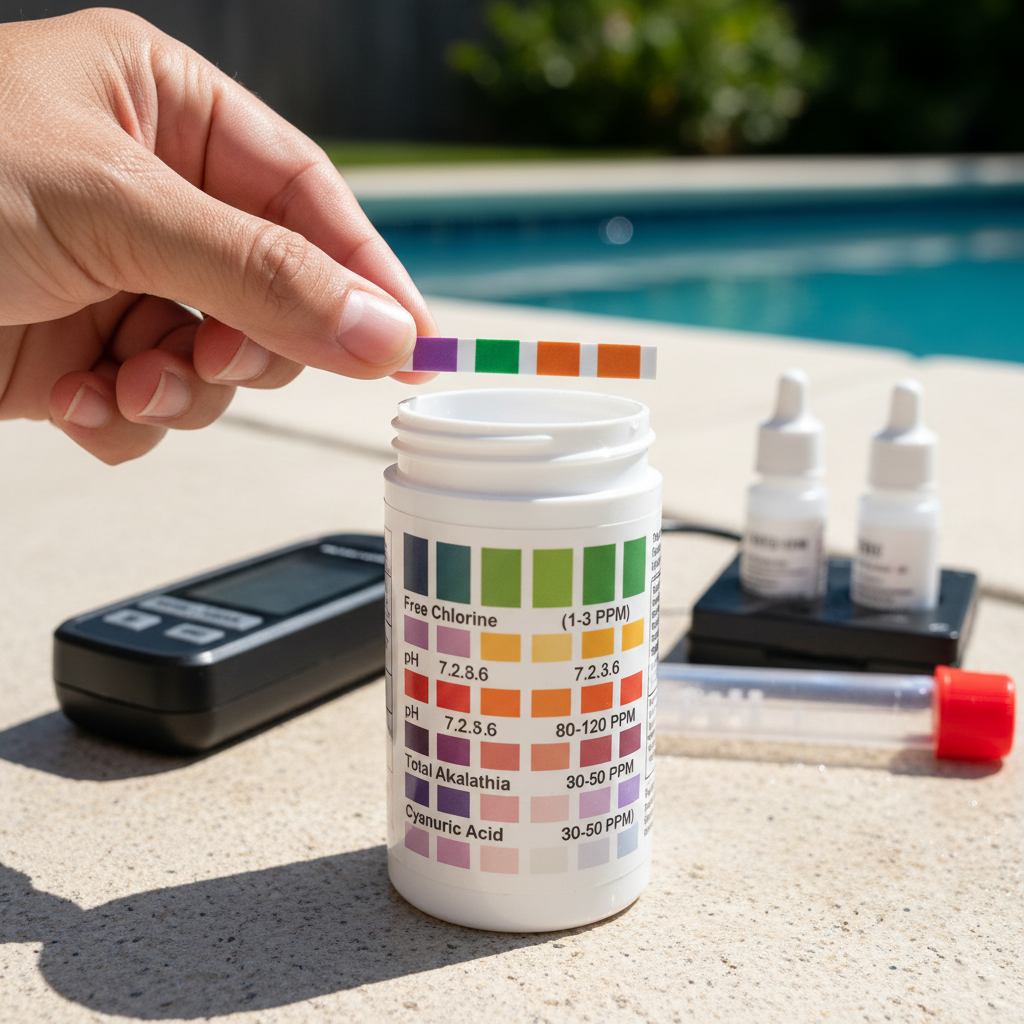
The Math:
Step 1: Add pH + TF + CF + AF
7.6 + 0.5 + 2.1 + 2.0 = 12.2
Step 2: Subtract TDS Constant
12.2 - 12.2 = 0.0
Result: 0.0 is a perfect LSI balance. Your pool water is neither corrosive nor scale-forming.
Interpreting Your Results & How to Fix Them
If LSI is Negative (< -0.3)
Diagnosis: Water is corrosive. It will eat grout and rust metal.
Fix:
- Raise pH
- Increase calcium hardness
- Add sodium bicarbonate to raise alkalinity
If LSI is Positive (> +0.3)
Diagnosis: Water is scale forming. It can cloud the water and clog your Aiper robot’s filter.
Fix:
- Lower pH with hydrochloric acid
- Dilute the pool to reduce calcium hardness
Conclusion
LSI is the true measure of pool water balance, not just pH or chlorine levels. Following SPASA guidelines helps maintain warranty compliance for pool equipment and keeps the water safe for swimmers. Test your water this weekend, tune the LSI, and let your Aiper robotic cleaner handle the heavy work while you enjoy a stress-free swim.
FAQ
Q: What is a good LSI number for a pool?
A: The ideal number is 0.0, and the acceptable range is between -0.3 and +0.3.
Q: Does salt affect the LSI calculation?
A: Yes. Salt raises TDS. For salt pools, you usually subtract 12.2 in the LSI formula.
Q: How often should I calculate LSI?
A: At least once a month, or any time water temperature shifts, especially at the start of swimming season.
References:
Swimming Pool & Spa Association of Australia.
- (n.d.). Pool & spa water balance. Retrieved from https://www.spasa.com.au/consumer-info/water-balance/
- (2023). Australian standard for swimming pool water quality. SPASA. https://www.spasa.com.au/