
Can You Shock a Saltwater Pool?


If you are a new saltwater pool owner, you might hesitate before dumping a bag of granular shock into your water. After all, you invested a significant amount of money into your salt chlorine generator specifically to avoid handling harsh chemicals.
There is a common fear that adding traditional shock will damage the expensive salt cell or throw the chemistry out of whack.
The short answer? Yes, you absolutely can—and should—shock a saltwater pool.
In fact, a saltwater pool is simply a chlorine pool that makes its own chlorine. However, the generator is designed for a marathon, not a sprint. When you are facing algae blooms, cloudy water, or the aftermath of a heavy storm, your salt cell needs help.
Here is how to shock your saltwater pool correctly, effectively, and safely.
Why Your Saltwater Pool Needs Shocking (Even if it Generates Chlorine)
Many owners assume that because their generator produces chlorine, they never need to add it manually. To understand why this is a myth, you have to look at how the equipment works.
Your salt cell is designed to maintain a steady, consistent level of chlorine (usually 1–3 ppm) to keep the water sanitary during normal use. Think of it as a "maintenance mode."
However, "maintenance mode" isn't enough to handle:
- Algae Blooms: Once algae takes hold—whether it's green or stubborn black algae—you need to reach "break point chlorination" (often 10–20 ppm or higher) instantly to kill it.
- Heavy Bather Loads: After a pool party, the sweat, sunscreen, and organic debris can overwhelm the steady trickle of chlorine your cell produces.
- Weather Events: Heavy rain dilutes your water and introduces phosphates and nitrogen.
If you rely solely on your salt cell to fix these problems, the algae will likely grow faster than the cell can produce chlorine. You need a manual shock to SLAM your pool (Shock Level and Maintain) and sanitize the water instantly.
The "Super Chlorinate" Button vs. Manual Shock
Most modern salt systems have a "Boost" or "Super Chlorinate" button. It’s tempting to press this and walk away, but it is not always the best solution.
- How "Super Chlorinate" Works: It commands the cell to run at 100% output for 24 hours.
- The Problem: It is slow. It takes hours to ramp up chlorine levels. If you are fighting an active algae bloom, time is your enemy. Furthermore, running your cell at 100% puts significant wear and tear on the plates, shortening the lifespan of an expensive component.
- The Solution: Manual shocking is instant. It spikes the chlorine immediately, killing bacteria on contact and saving your salt cell from overwork.
The Best Pool Shock for Saltwater Pools
Not all shock products are created equal. Because saltwater pools are prone to calcium scaling and pH drift, you need to be selective about what you add.
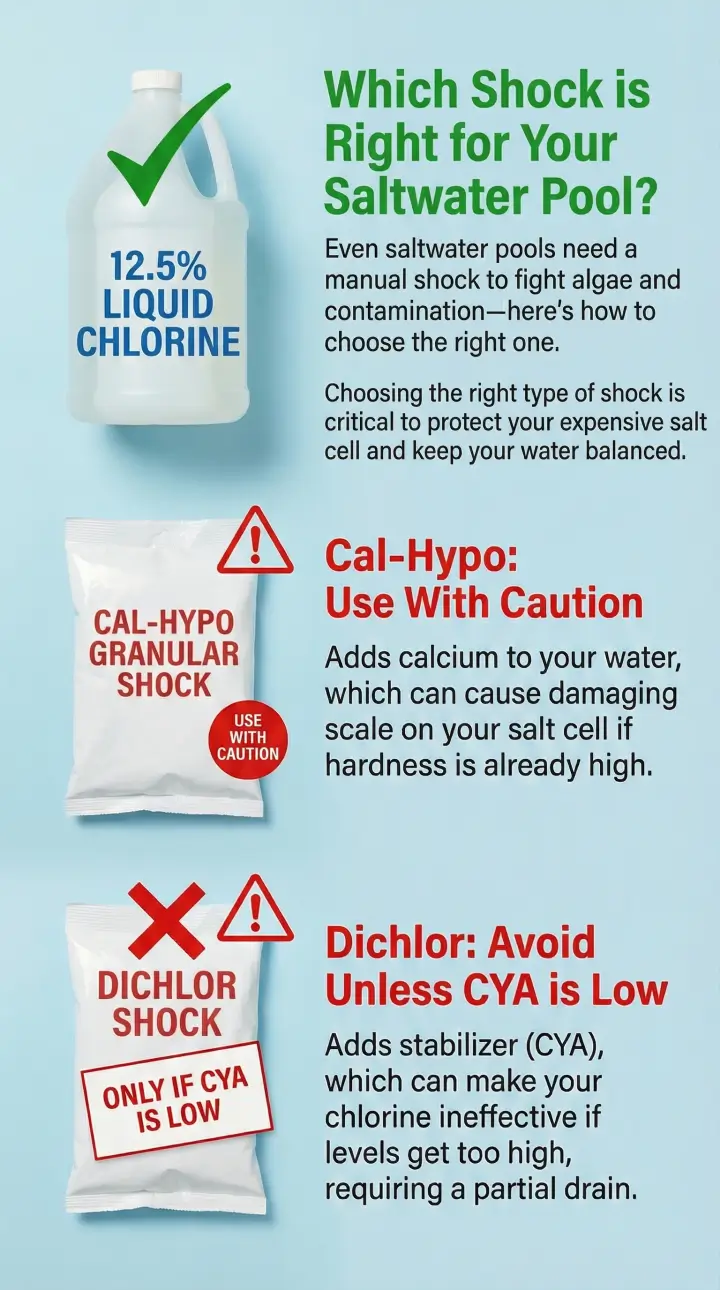
1. Liquid Chlorine (Sodium Hypochlorite) – The Gold Standard
This is widely considered the best shock for saltwater pools.
- Why: Unlike tablets or some powders, liquid chlorine dissolves instantly and does not add calcium (which causes scale on your salt cell) or cyanuric acid (which can over-stabilize the water).
- Verdict: Highly Recommended.
2. Cal-Hypo (Calcium Hypochlorite)
This is the most common granular shock found in stores.
- Why: It is powerful and effective. However, it adds calcium to the water.
- Verdict: Use with caution. If your Calcium Hardness is already high (over 400 ppm), avoid this, as it will cause scale buildup on your salt cell plates.
3. Dichlor (Granular Stabilized Shock)
- Why: It contains built-in stabilizer (cyanuric acid).
- Verdict: Only use this if your stabilizer levels are low. Salt pools generally need lower stabilizer levels than tablet-pools. If your stabilizer gets too high, your chlorine becomes ineffective, and you will have to drain the pool.
How to Shock a Saltwater Pool: A Step-by-Step Guide
Ready to clear up that water? Follow these steps to protect your equipment and ensure a clean swim.
Step 1: Test Your Water First
Before you shock, test your pool water to check your pH. Chlorine becomes significantly less effective if your pH is too high. Aim to lower your pH to between 7.2 and 7.4 before adding shock for maximum killing power.
Step 2: Turn Off the Salt Cell
While not strictly mandatory, it is a smart "best practice" to turn off your salt chlorine generator (or dial it to 0%) before adding shock. This prevents the electronics from reading erroneous salt levels during the chemical spike and protects the cell plates.
Step 3: Prepare the Circulation
Your pump needs to be running to distribute the chemical. However, remove any robotic cleaners from the pool before shocking. High concentrations of acid and chlorine can degrade the plastic and seals of your cleaner over time.
Step 4: Add the Shock
- For Liquid: Pour it slowly around the perimeter of the deep end.
- For Granular: Pre-dissolve it in a bucket of water (if required by the package) or broadcast it evenly across the surface. Never pour shock directly into the skimmer; this sends a concentrated "bomb" of chemicals straight into your heater and pump seals.
Step 5: Run the Pump and Clean Up
Leave the pump running for 24 hours to circulate the water.
Once the shock has done its job (usually 24 hours later) and chlorine levels have dropped back to a safe swimming range, you will likely see gray or white dust on the floor. This is the dead algae and organic debris.
Now, you can re-deploy your cleaner. A powerful unit like the Aiper Scuba X1 Pro Max is ideal for this post-shock recovery. Its dual-filtration system is designed to capture the fine particulate matter left behind after a shock treatment, scrubbing the floor and walls to ensure the dead algae doesn't just settle and rot.
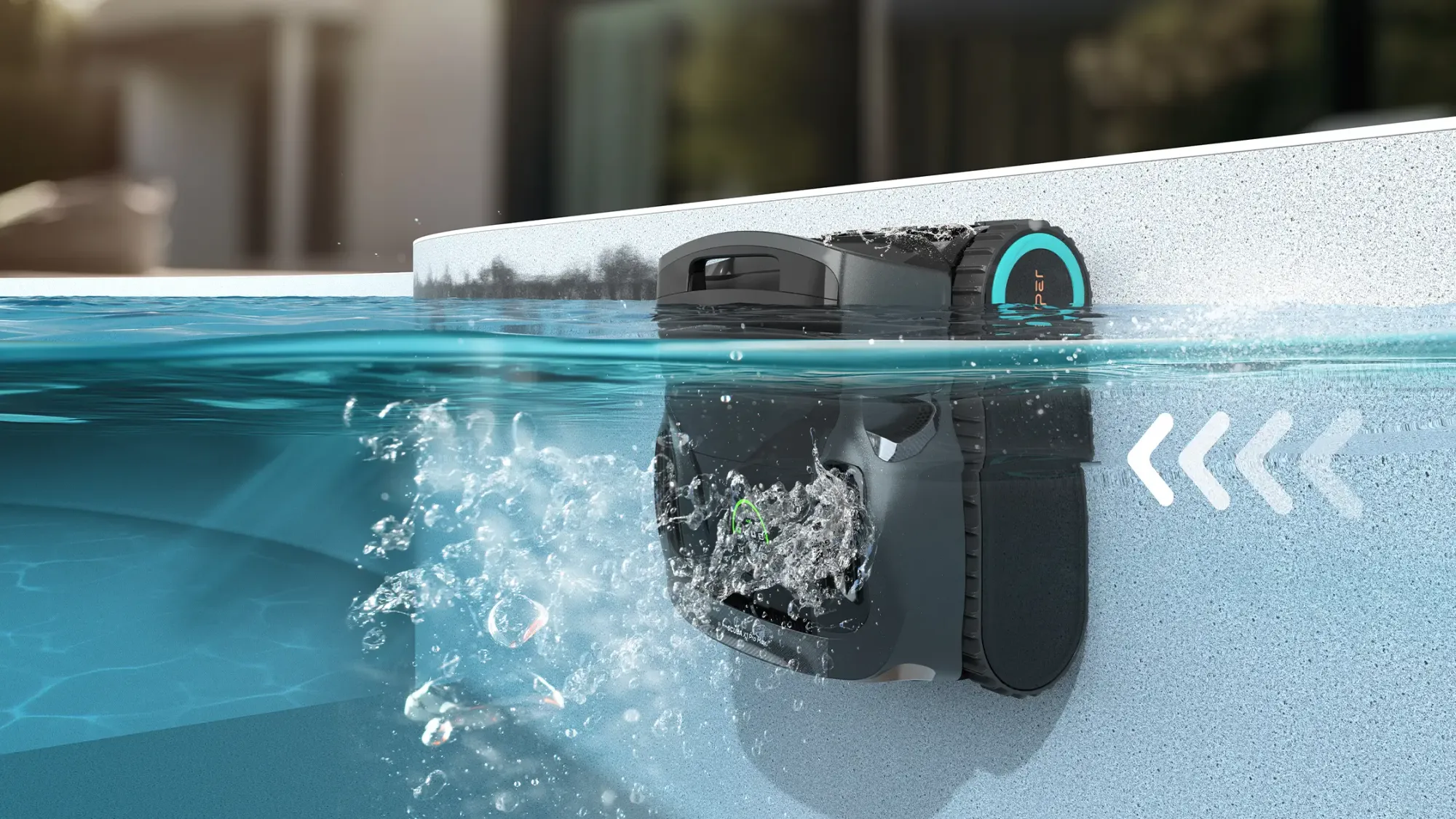
Pro Tip: For large pools or deep ends where signals can drop, pairing your cleaner with the Aiper HydroComm ensures you maintain a stable connection with your device, allowing you to monitor the cleanup progress from your phone without hovering over the water.
3 Common Mistakes That Ruin Salt Pools
- Ignoring High Stabilizer (CYA): Many salt owners don't realize that granular shock adds stabilizer. If your CYA goes over 80-100 ppm, no amount of shock will clear a green pool.
- Using "Splashless" Bleach: If you are buying liquid chlorine from a grocery store, ensure it is plain bleach. "Splashless" or scented versions contain polymers that will cause your pool to foam uncontrollably.
- Shocking During the Day: The sun burns off chlorine rapidly if it isn't stabilized. Always shock at dusk or night to give the chemical the full night to work without UV interference.
The Bottom Line
Don't be afraid to shock your saltwater pool. It is a necessary tool in your arsenal to keep water crystal clear and safe for your family. By using liquid chlorine and relying on manual shocking rather than overworking your salt cell, you extend the life of your equipment.
Once the chemistry is balanced and the water is safe, let your robotic pool cleaner handle the physical labor of scrubbing the rest, so you can get back to enjoying the water.