
Corded vs. Cordless Pool Cleaners: Which Robot Is Right for You?

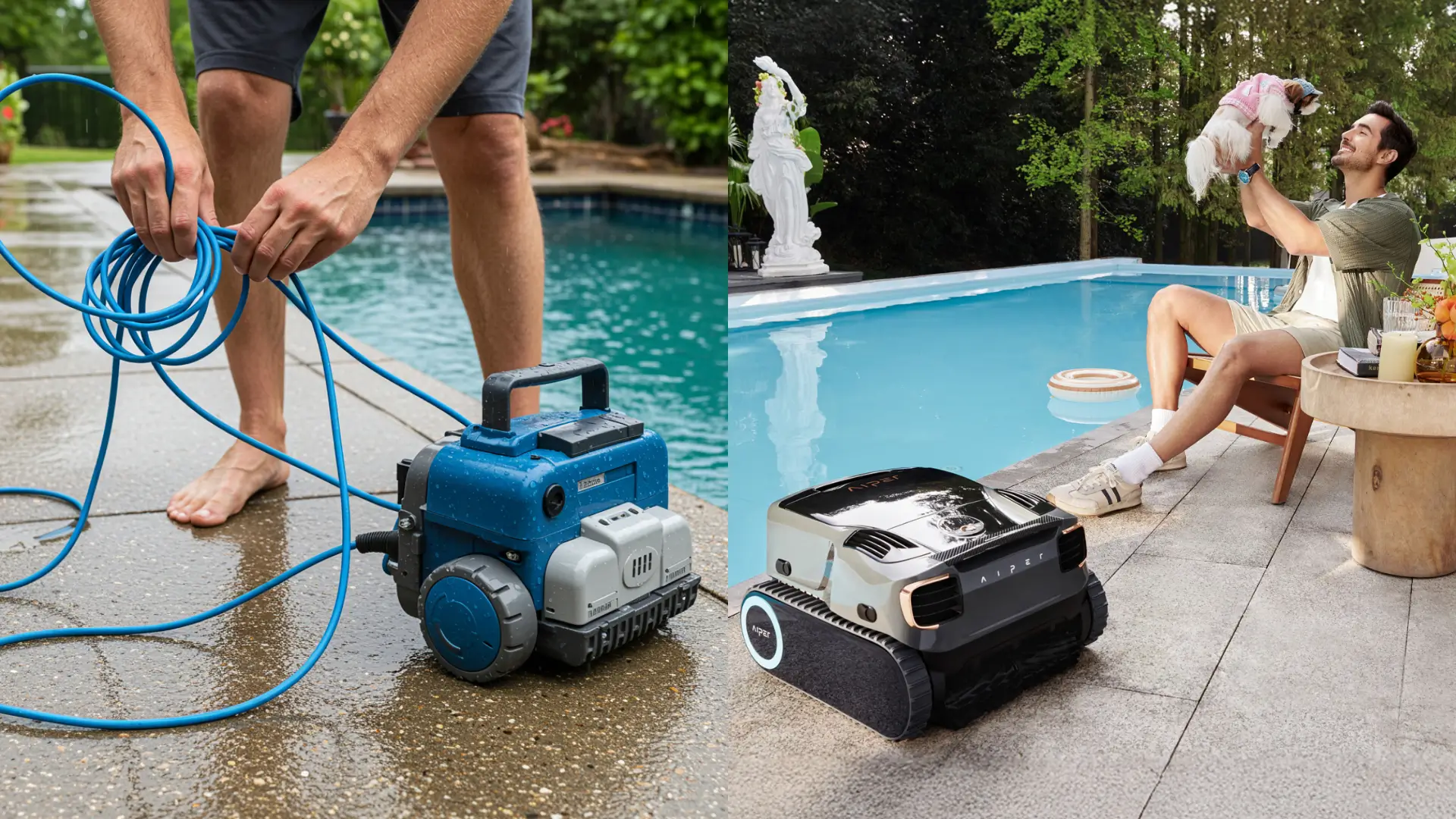
If you are comparing corded vs. cordless pool cleaners, you are already on the right track. Switching to a robotic cleaner is the single best thing you can do for your pool maintenance routine.
But the "power source" choice can decide whether you love your robot or quietly hate it.
Corded cleaners offer the security of unlimited power, but you live with a tether. Cordless cleaners feel effortless and modern, but you live on a battery clock. The wrong choice can become a new chore: a cable that twists into a weekly wrestling match, or a battery that quits before the deep end is done.
Let’s break down the factors that actually matter when you own one.
Head-to-Head: The Factors That Matter
Before you compare specific models, you need to decide which trade-off you can live with: a cable or a charging routine. Most buyers don’t regret the cleaning result; they regret the day-to-day friction.
| Factor | Corded Pool Cleaner | Cordless Pool Cleaner | The Verdict |
|---|---|---|---|
| Run Time | Unlimited. Runs as long as the power supply is on. | Limited. Dependent on battery capacity (usually 90–180 mins). | Corded wins for massive commercial pools. |
| Setup | High Friction. Requires dragging out the power supply and floating cable. | Low Friction. Drop in, press start. | Cordless wins for daily ease of use. |
| Tangles | Likely. Swivels help, but cables eventually twist or snag. | Impossible. No tether to tangle. | Cordless is superior for complex pools. |
| Deck Clutter | High. Cable lies across the deck and water during use. | Zero. The deck remains clear while the robot works. | Cordless wins on safety/aesthetics. |
| Wear Item | The Cable. Connectors and wires degrade over time. | The Battery. Capacity naturally fades over years. | Tie (Choose your maintenance preference). |
Suction Power & Performance
Corded used to be the safe bet for "strong cleaning." That is not automatically true anymore.
Advancements in lithium-ion density and brushless motor efficiency have allowed modern cordless robots to rival their tethered cousins. The practical point to remember is that cleaning isn't just about GPM (Gallons Per Minute) of suction. It is about coverage. If a corded robot gets snagged on a ladder, its suction power doesn't matter. A cordless robot that moves freely often results in a cleaner pool, simply because it reaches more spots.
Ease of Use & Maintenance
Corded ownership usually means handling 50–60 feet of wet cable and winding it onto a caddy after every use. Cordless ownership usually means rinsing the filter and placing the unit on a charging dock. Neither is "hard," but the cable management is significantly messier.
Corded vs. Cordless Pool Cleaners: How They Work
Both robotic vs. suction pool cleaners do the same job in the water: they drive around, scrub surfaces with brushes, and pull debris into an internal filter. The difference is strictly power delivery.
Corded Pool Cleaners (The Traditional Choice)
A corded robot depends on an external Power Supply Unit (PSU) that sits on your pool deck. A floating cable connects that power supply to the cleaner.
- The Pro: The PSU converts standard outlet electricity to low-voltage DC power, running the robot indefinitely.
- The Con: That cable becomes part of the ownership experience. You have to lay it out, manage it during use, and coil it afterward.
Cordless Pool Cleaners (The Modern Evolution)
A cordless robot carries its power inside the unit. You charge it, drop it in, and let it work with no cable to snag on ladders or twist over time.
- The Pro: This is the "drop-and-go" appeal. It lowers the effort required to clean your pool.
- The Con: Runtime depends on the battery. Charging becomes the routine instead of cable management.
Analyzing Corded Pool Cleaners
The Advantages of Going Corded
- Unlimited Run Time: A corded robot does not care about battery percentage. If you need a 4-hour cycle for a spring opening, you can run it.
- Consistent Power: Output stays steady from the first minute to the last.
The Downsides of the Cord
- The Tangle Factor: This is the #1 user complaint. Even with "anti-tangle" swivels, grit gets into the mechanism, and cords eventually twist.
- Limited Reach: You are tethered by cable length. If you have an L-shaped pool, the cable might pull tight before the robot reaches the far corner.
- Aesthetics: A blue cable snaking across your patio is a tripping hazard and an eyesore.
Analyzing Cordless Pool Cleaners
Cordless cleaners are built around one simple idea: remove the cable, remove the hassle. For most residential pools, this makes the whole ownership experience feel easier.
The Advantages of Cutting the Cord
- True "Drop-and-Go" Convenience: No power box. No unwinding cables. Just turn it on and submerge. This convenience often means you run the robot more frequently.
- Safety & Aesthetics: With no cord on the deck, you cut down on clutter. This is a major safety factor if you have children or pets running around the pool area.
- Better Coverage for Complex Pools: No cord means nothing to snag on ladders, drains, rock features, or islands. In pools with obstacles, cordless robots like the Aiper Scuba X1 Pro Max move freely and finish cycles with fewer interruptions.
The Downsides to Consider
- Charging Discipline: Cordless only works if it’s charged. If you forget to dock it after the last clean, you aren't cleaning today.
- Retrieval: You can’t pull it out by a cord. You use a hook (usually included) to lift it from the pool.
Corded vs. Cordless: Which One Fits Your Pool?
Don’t pick based on what sounds "more powerful." Pick based on what will feel easiest to own for the next few years.
You Should Choose Corded If...
- You have an exceptionally large commercial pool requiring 4+ hour cleaning cycles.
- You never want to think about charging a battery.
- You don't mind the sight of a cable lying across your pool deck.
You Should Choose Cordless If...
- You have obstacles: Islands, pillars, swim-up bars, or ladders are cable traps. Cordless units navigate these without getting "clotheslined."
- You value a clean look: You want your pool area to look photo-ready, without tripping hazards.
- You want "Set it and Forget it": You have a busy schedule and want the simplest workflow: start a cycle fast and move on with your day.
- You are asking, are robotic pool cleaners worth it? If convenience is your answer, cordless is the only way to go.
Conclusion
Corded pool cleaners have been the workhorse of the industry for decades. They remain a solid choice if you need uninterrupted cleaning time and refuse to manage a charging routine.
But for most residential pools, cordless technology has matured. The convenience is real. Without a cable to manage, many owners find they actually use the robot more often, which keeps the pool consistently cleaner.
Pick the cleaner that removes work from your life, not the one that replaces one chore with another.
- If you know a wet cable and occasional tangles will annoy you every week, don't sign up for that.
- If you want a hassle-free, powerful clean that navigates your pool intelligently, it's time to cut the cord.
Ready to experience the freedom of cordless cleaning? Check out the Aiper Scuba X1 Pro Max and see why modern pool owners are ditching the tether.
FAQ on Corded vs. Cordless Pool Cleaners
Do cordless pool cleaners last as long as corded ones?
They can, but the "wear point" is different. A corded cleaner often lives or dies by the condition of its cable over time (shorts/breaks). A cordless cleaner relies on battery health. In real ownership terms, it’s less about which category lasts longer and more about which maintenance you prefer.
How do I get a cordless cleaner out of the deep end?
You don’t pull it out by a cord. Most cordless robots are designed to auto-park near a wall, or you retrieve them using a standard pool pole with a hook attachment. It takes about 10 seconds and eliminates the need to haul in 50 feet of wet cable.
Can a cordless cleaner handle a dirty pool on one charge?
It depends on the severity. For routine maintenance, yes. If your pool is opening for the season and is filled with leaves, you may need to run one cycle, empty the basket, recharge, and run a second cycle.