
What Does Pool Clarifier Do? Fix Cloudy Pool Water Fast
Chemicals only work if they reach the bacteria. Proper circulation acts as the pool's "heart," moving water through the filter and eliminating stagnant dead zones to ensure your sanitizers can effectively maintain a crystal-clear swim.

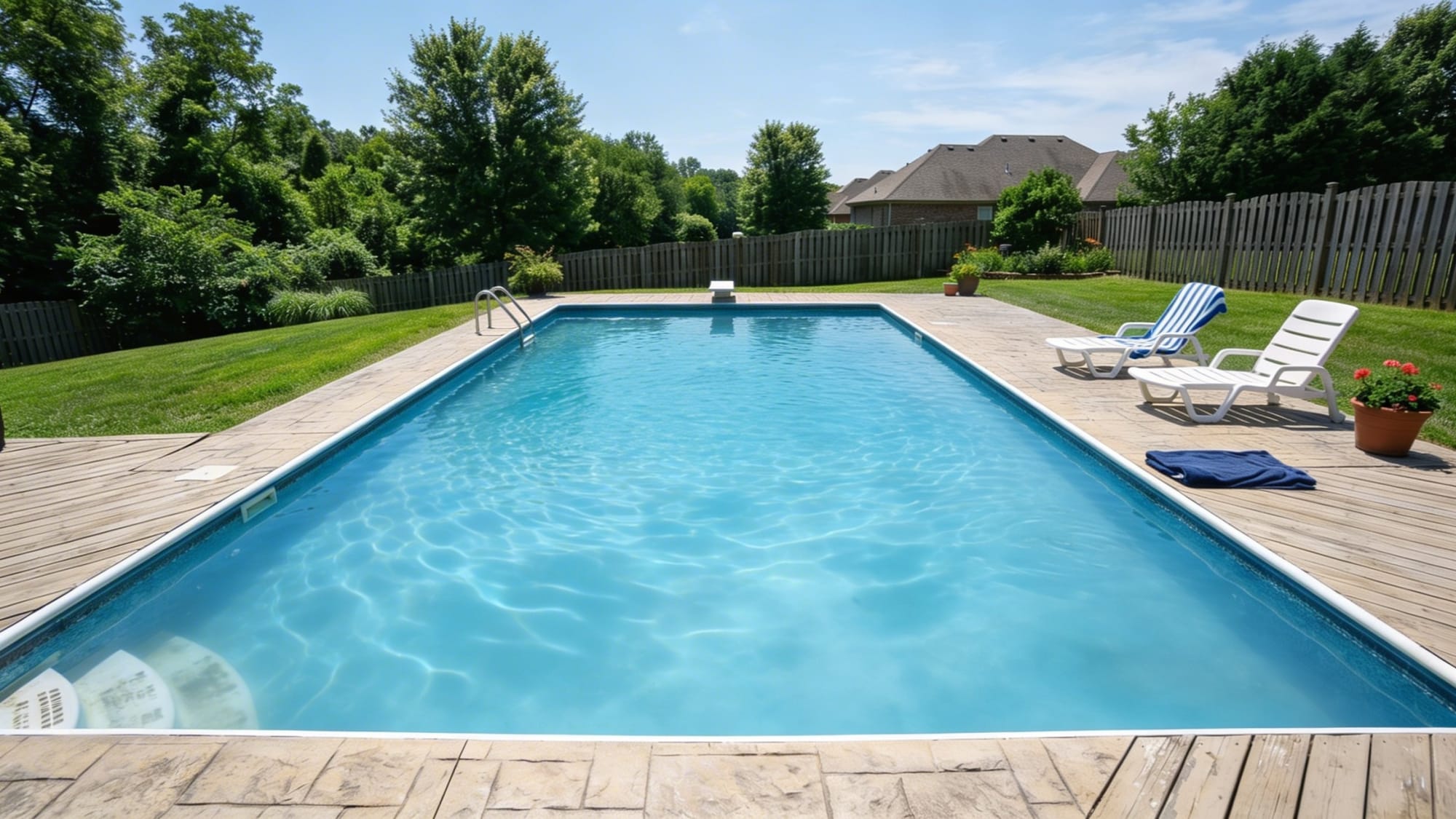
Cloudy water can often come down to particle size, not a lack of effort. A typical sand filter is generally described as catching particles around 20–40 microns, while the “haze” you see can be made of much smaller debris that slips right through the system.
If you are staring at cloudy pool water even though you’ve been brushing, skimming, and running the pump, you are not alone. And if you’re standing in the pool store wondering what a pool clarifier actually does, the simplest answer is: it doesn’t "kill" anything. It helps your water filter better.
A pool clarifier works by making tiny, suspended particles stick together into bigger clumps. Once they are bigger, your circulation system and filter finally have something they can grab and remove. That is why a clarifier can be a smart fix for a mild, stubborn haze—especially after you have already handled the real root cause (like low sanitizer, off-balance water, or leftover dead algae).
The Science Simply Explained: How Pool Clarifiers Work
A pool clarifier is essentially a coagulant—it makes microscopic debris catchable. It doesn’t sanitize the water; it simply helps tiny matter stop floating long enough to be physically removed.
Coagulation: Grouping Microscopic Particles Together
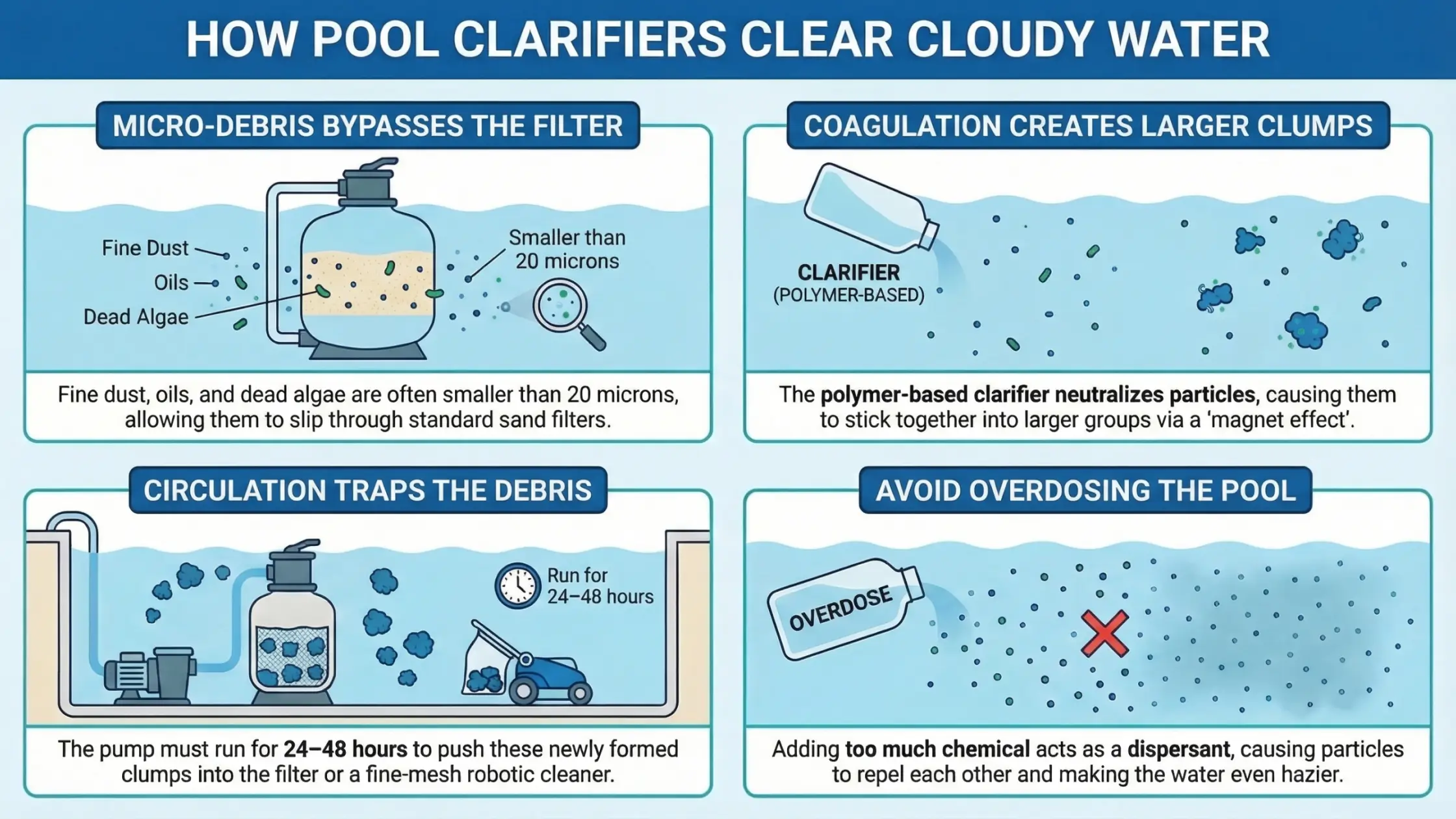
Most pool haze is made of microscopic particles—fine dust, oils, and dead algae—that are so small they stay suspended indefinitely. Clarifiers use polymer-based chemistry to neutralize that “won’t-stick” behavior and bridge many tiny particles into bigger clumps. Think of it as a gentle magnet effect. The dirt isn’t gone yet; it’s just grouped into pieces that are easier to trap.
The Role of Your Filtration System
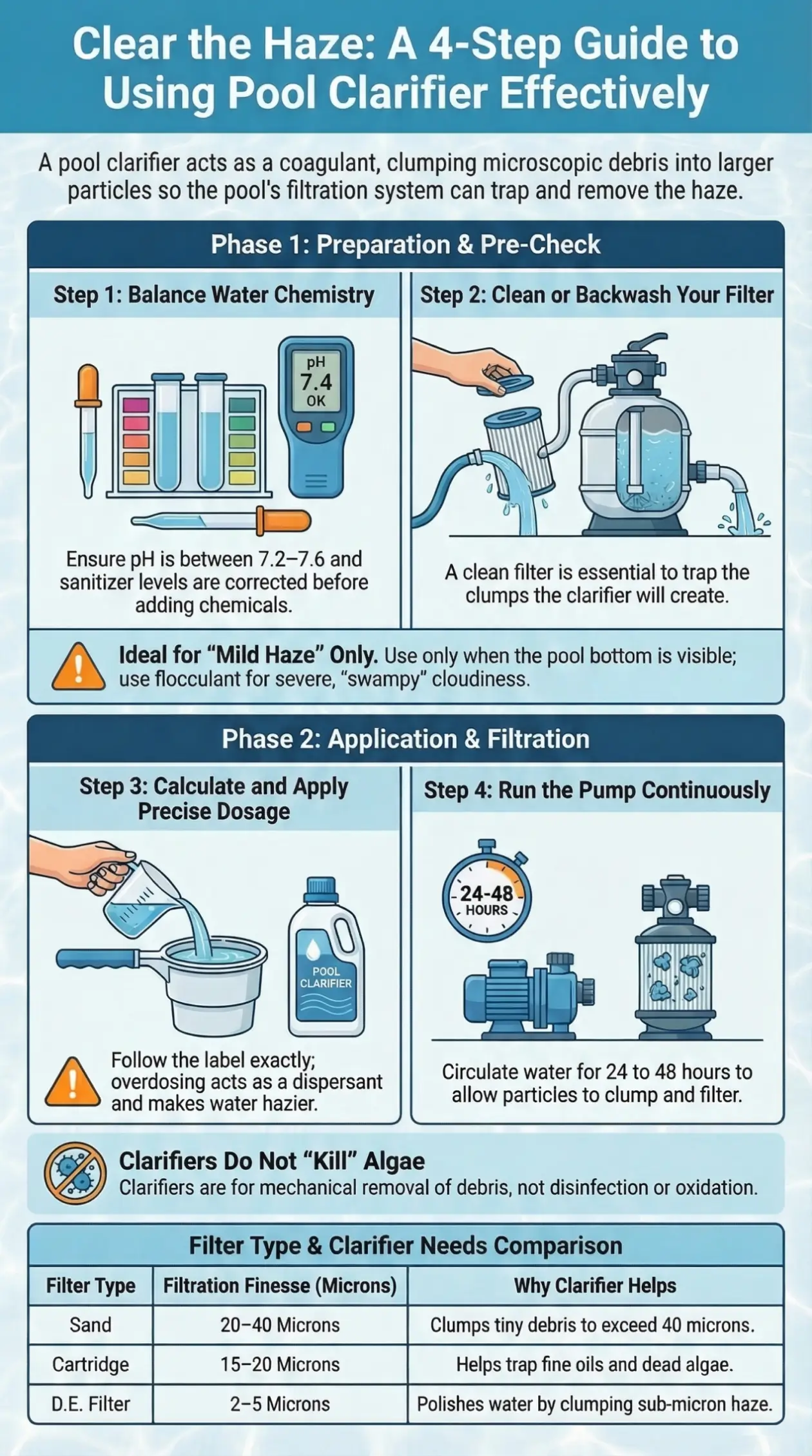
This part matters: the clarifier doesn’t remove the debris—your filtration does. Once particles clump, they still need to be carried to (and trapped by) a clean, running filter. And filters have limits: typical filtration "finesse" is around 20–40 microns for sand, 15–20 microns for cartridge, and 2–5 microns for D.E. filters.
A robotic cleaner can also help by picking up clumped particles that settle on the floor or walls. For example, advanced robotic cleaners like the Aiper Scuba X1 Pro Max are engineered with MicroMesh™ ultra-fine filters capable of capturing debris as small as 3 microns. This provides crucial secondary support while your main filter does the heavy lifting.
Pool Clarifier vs. Flocculant: What’s the Difference?
Pool clarifier and flocculant (floc) both deal with cloudiness. But they clear it in entirely different ways—and they ask different things from you.
Here is the clean split: a clarifier helps your filter catch the haze. Floc drops the mess to the floor so you can vacuum it out to waste.
| Feature | Pool Clarifier | Pool Flocculant (Floc) |
|---|---|---|
| Application Time | Slower, gradual clearing (24–48 hours) | Faster, "overnight" settling |
| Mechanism | Makes tiny particles clump so the filter can remove them. | Creates heavy clumps that sink and must be removed manually. |
| Labor Required | Low (mainly circulation + filter cleaning) | High (pump off to settle + vacuum to waste) |
| Ideal Use Case | Mild haze (you can still see the pool bottom) | Severe cloudiness / Post-algae cleanup (can't see the bottom) |
When to Use a Clarifier (Mild Cloudiness)
Use a clarifier when your water looks dull or hazy, but not swampy—especially when the issue feels like fine particles that won’t filter out. Clarifiers are positioned for mild cloudiness, where your filtration system and time can do the work once the particles are clumped.
When to Use a Flocculant (Severe Cloudiness)
Use floc when the pool is truly murky and you need a dramatic reset. Floc binds particles into heavy masses that sink to the floor.
Important: Floc is a manual-vacuum job. You must vacuum to "waste" to physically remove the debris so it doesn't enter your filter. Many cartridge-filter setups can’t easily vacuum to waste, so always verify your equipment limits first.
Is Pool Clarifier the Same as Shock?
No—these products do completely different jobs.
- Shock is about oxidation (and sometimes disinfection). It kills the bacteria and algae.
- Clarifier is not an oxidizer. It doesn’t "kill" anything. It helps group the tiny particles (like the dead algae left over after shocking) so they can be removed by filtration.
That is why the order matters. If the cloudiness is being caused by an active algae bloom, you must handle the sanitation and oxidation first with a shock treatment. Then, use a clarifier to help your filter catch the fine, dead leftovers.
How to Use a Pool Clarifier Effectively
A pool clarifier works best when your water is already "close." Think mild haze, not an active green pool. The goal is simple: balance your water, prep your filter, and give the clarifier enough circulation time to do its job.
Step 1: Balance Your Pool Chemistry First
Clarifiers can’t fix the root cause if your water chemistry is off. Start by testing and correcting the basics—especially your sanitizer and pH (aiming for a pH of 7.2–7.6). If you suspect an active algae bloom, handle that first.
Step 2: Clean or Backwash Your Filter
A clarifier doesn’t remove anything by itself; it creates clumps that your filter needs to catch. Therefore, you want your filter clean and flowing well before you add the chemical.
Step 3: Calculate the Correct Dosage
Never treat a clarifier as a "more is better" product. The dosage is highly brand-specific, so read the bottle carefully.
- Calculate your true pool volume.
- Follow the exact cloudy-water dose on the label.
- If the label allows repeat dosing, wait the full recommended window before adding more.
Step 4: Add the Clarifier and Run the Pump
Add the clarifier while your pump is running, then keep the water moving so those newly formed clumps can reach the filter. Most clarifiers require continuous filtration for 24 to 48 hours to fully clear the haze.
What Happens If You Add Too Much Clarifier?
Adding too much clarifier will backfire. Instead of helping particles stick together, overdosing acts as a dispersant. This means the tiny particles will actually repel each other and stay suspended, making the water look even hazier. Never overdose your clarifier.
If your water won’t clear after you’ve overdosed, you may need to partially drain and refill your pool to dilute the chemical concentration back to a workable level.
Conclusion
A pool clarifier is a polish product. It helps when your water is almost clear but still looks hazy because the particles are too small for your filter to catch.
If the pool is green, fix your sanitizer levels first. If the water is a full-on swamp, a flocculant is the better tool. And whatever you choose, dose carefully.
The ultimate long-term win is a simple, preventative system: steady circulation, a clean filter, and regular debris removal. Upgrading to smart pool cleaning automation ensures fine debris is scrubbed and removed daily, preventing that invisible gunk from ever breaking down into a cloudy water problem in the first place.
Frequently Asked Questions
How long does it take for a water clarifier to work?
Most clarifiers need time and continuous circulation. Generally, you should expect it to take 24 to 48 hours to see noticeably clearer water, assuming your pump is running non-stop and your filter is clean.
When should I put a clarifier in my pool?
Clarifiers make the most sense when the pool is chemically balanced and safe, but still looks dull. The best times to use it include:
- After shocking the pool: To filter out the fine, dead algae leftovers.
- After heavy rain or storms: When fine environmental debris leaves the water hazy.
- After high bather loads: When heavy weekend use leaves behind microscopic oils and sunscreens that need help filtering out.