
What is Evapotranspiration and How to Perfectly Water Your Lawn


Overwatering or underwatering a lawn leads to wasted water, higher bills, fungal disease, and dry, dead patches that feel impossible to fix. Most homeowners rely on guesswork, and guesswork rarely matches what the lawn actually needs. The most reliable way to stop guessing is to understand what evapotranspiration is. Evapotranspiration, commonly called ET, describes the total amount of water your lawn loses to the atmosphere through the soil and the grass itself. When you know how much water is leaving, you know exactly how much must be replaced.
This guide explains evapotranspiration using clear, practical language and shows how to convert ET data into the exact run time your sprinklers need. You will learn the difference between transpiration vs. evaporation, why ET is the foundation of scientific lawn watering, and how to build a precise lawn watering schedule using real numbers instead of assumptions.
What is Evapotranspiration, and Why is it the Key to Water Conservation?
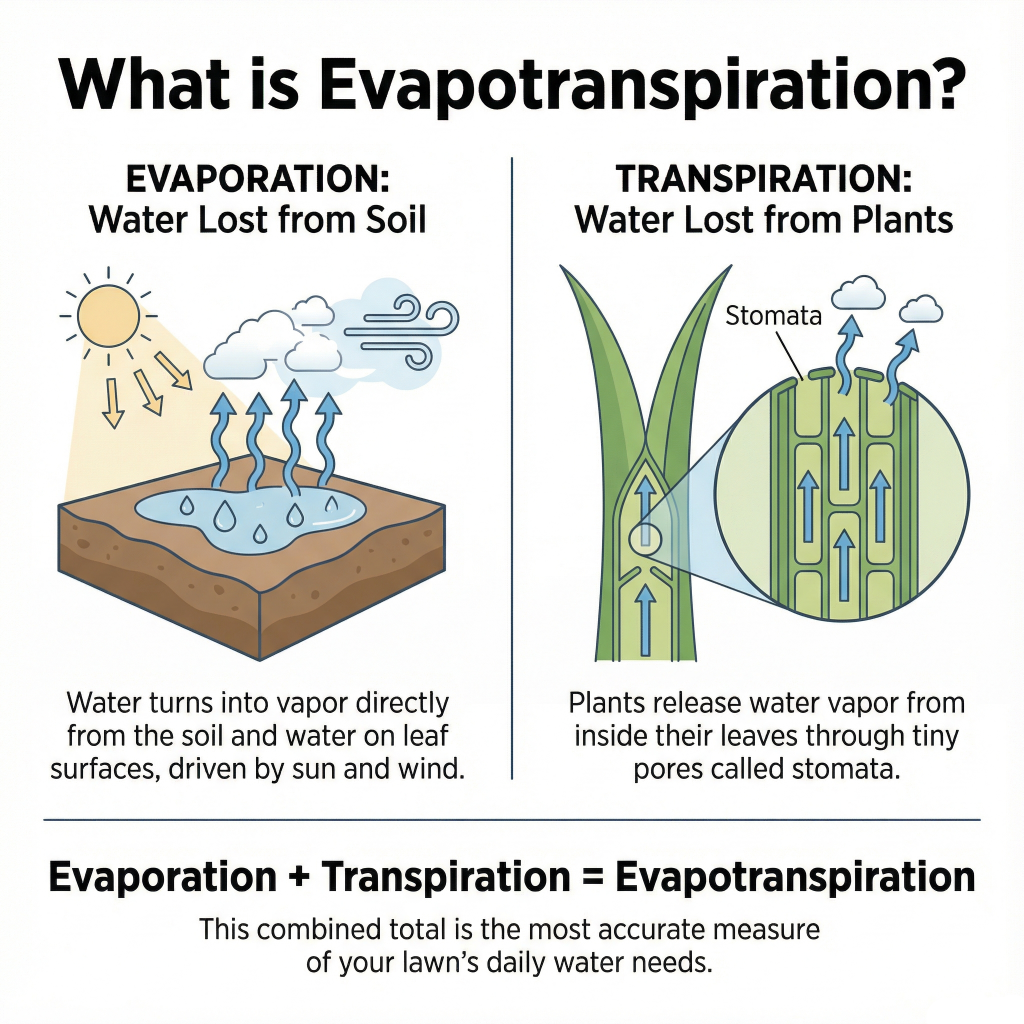
Evapotranspiration is the combined process of evaporation from soil and water surfaces and transpiration from plant leaves. According to the USGS, ET represents the movement of water from land surfaces and vegetation back into the atmosphere and forms a major component of the global water cycle. Wikipedia further explains that ET is affected by radiation, soil moisture, temperature, humidity, wind, and plant type. Because it measures the actual amount of water lost, ET is one of the most accurate tools for estimating irrigation needs.
ET is expressed as a depth of water, such as inches per day or week. If your lawn loses 0.25 inches of water today, you must replace 0.25 inches to keep the soil moisture balanced. This transforms irrigation from guesswork into a measurable process.
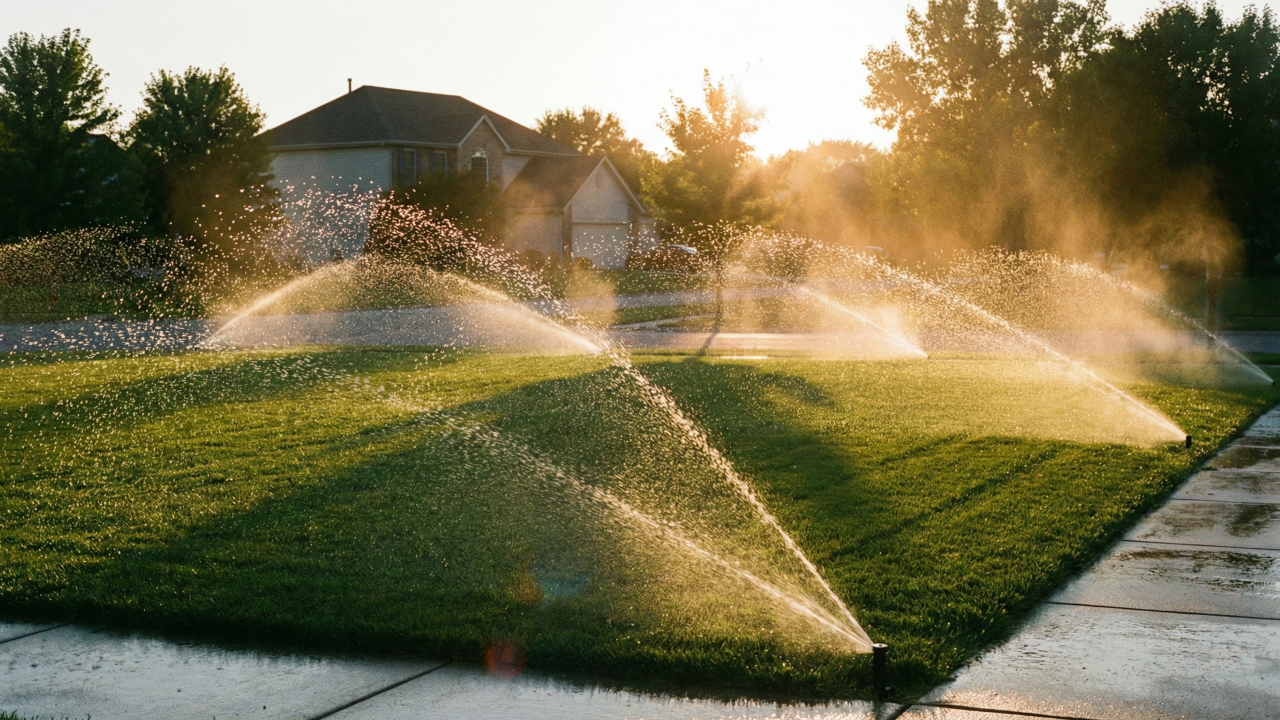
Colorado State Extension notes that water requirements vary widely depending on grass type, climate, and soil structure, but ET allows you to adjust watering based on real conditions rather than fixed schedules. For homeowners using smart water practices, ET provides an exact target that prevents overwatering while keeping grass healthy.
Evaporation vs. Transpiration: Separating the Water Loss
Evaporation is the water that leaves the soil surface or grass canopy directly as vapor. Factors that increase evaporation include sunlight, heat, wind, and low humidity. When the soil surface is warm and exposed, evaporation speeds up.
- Transpiration occurs inside the plant. Water moves from the roots to the leaves and exits through tiny openings called stomata. UCANR notes that transpiration helps plants regulate temperature and maintain nutrient flow. Without transpiration, grass cannot cool itself or grow normally.
- Evapotranspiration is the sum of both processes, which is why it is the most complete measurement for determining how much total moisture the lawn needs.
Step-by-Step: Converting ET Rates to Your Lawn's Irrigation Time
The goal is simple. Use your ET rate to calculate the exact number of minutes your sprinkler system must run to replace that lost water.
You only need three pieces of data:
- Local ET rate (inches of water lost)
- Lawn size
- Sprinkler precipitation rate or PR
The sprinkler PR tells you how fast your sprinklers apply water, measured in inches per hour. The EPA and UCANR recommend using a catch-can test or manufacturer data to determine your PR.
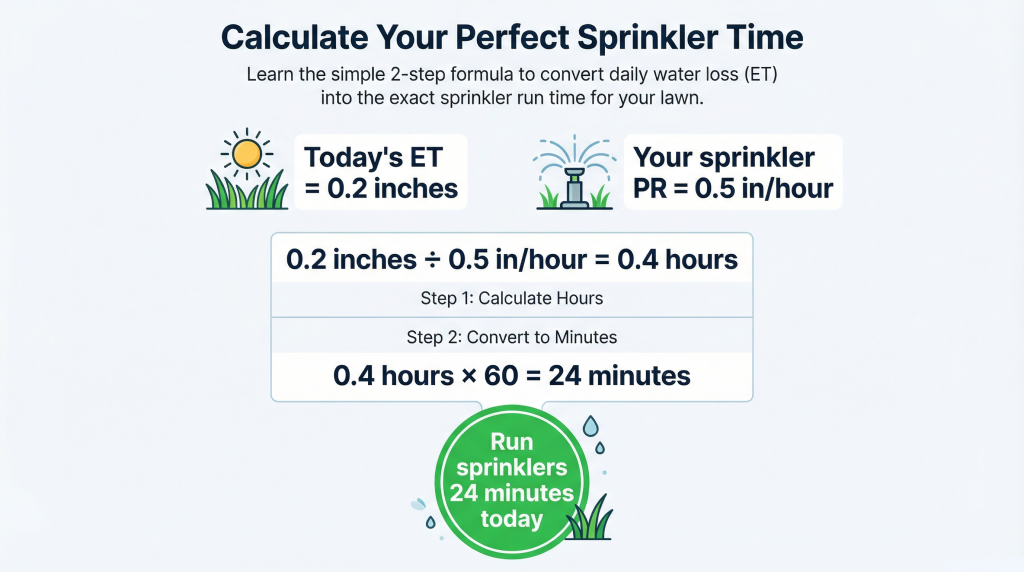
Step 1: Calculate the Total Required Time (Hours):
Total Time (Hours) = ET (Inches) ÷ Sprinkler Precipitation Rate (Inches per Hour)
Step 2: Convert to Minutes (for easy programming):
Total Time (Minutes) = Total Time (Hours) × 60
As long as both values are in inches, the calculation stays simple and accurate.
Case Study: Calculating Water Needs with a Simplified ET Table
| Weather Scenario | Hypothetical Daily ET (Inches) | Weekly Water Needed (Inches) |
|---|---|---|
| Cool or Cloudy | 0.10 | 0.70 |
| Hot or Sunny | 0.25 | 1.75 |
| Extreme Heat or Windy | 0.35 | 2.45 |
Example:
If your ET is 0.2 inches today and your sprinkler PR is 0.5 inches per hour, the math looks like this:
0.2 ÷ 0.5 = 0.4 hours
0.4 × 60 = 24 minutes
Your sprinklers should run for 24 minutes to replace the moisture your lawn lost.
Common Pitfalls and Considerations When Using ET
- Soil Type. Sandy soil drains quickly and needs more frequent irrigation. Clay soil holds water longer and should be watered less often, even if the total weekly ET is the same. These concepts are consistent with Colorado State Extension guidance.
- Grass Type. Warm-season grasses use water more efficiently in hot conditions, while cool-season grasses require higher water input during active growth.
- Microclimates. Shade, reflected heat from pavement, tree cover, and wind exposure can make your backyard differ from the ET measured at a nearby weather station. Adjust as needed.
- Runoff Risk. The EPA warns that if you apply water faster than the soil can absorb it, runoff will occur even when ET calculations are correct. Water in shorter cycles if needed.
Conclusion
Understanding what evapotranspiration is turns lawn care into a science rather than a guessing game. ET tells you exactly how much water your lawn loses, which means you know exactly how much to replace. When you combine local ET data with the simple formula in this guide, you can create a lawn watering schedule that saves water, protects soil, and keeps your grass consistently healthy. Smart irrigation devices make this even easier by adjusting watering in real time.
FAQ: Quick Answers on Evapotranspiration
How do I find my local Evapotranspiration data?
Answer: Check local weather services, agricultural extension stations, irrigation district websites, or specialized smart weather apps.
How often should I apply my weekly ET total?
Answer: Most lawns do best with deep watering two to three times per week. This encourages deeper roots and reduces waste compared to daily shallow watering.
What is the average ET rate in summer?
Answer: Typical summer ET ranges from about 0.15 to 0.35 inches per day, depending on climate, humidity, and wind. Always check your specific region for accuracy.