
Can You Swim in a Green Pool? The Real Risks and How to Fix It Fast
Never swim in a green pool; it’s a bacteria-filled safety hazard. Fix it fast by removing debris, balancing pH, shocking with chlorine, scrubbing walls, and filtering 24/7.

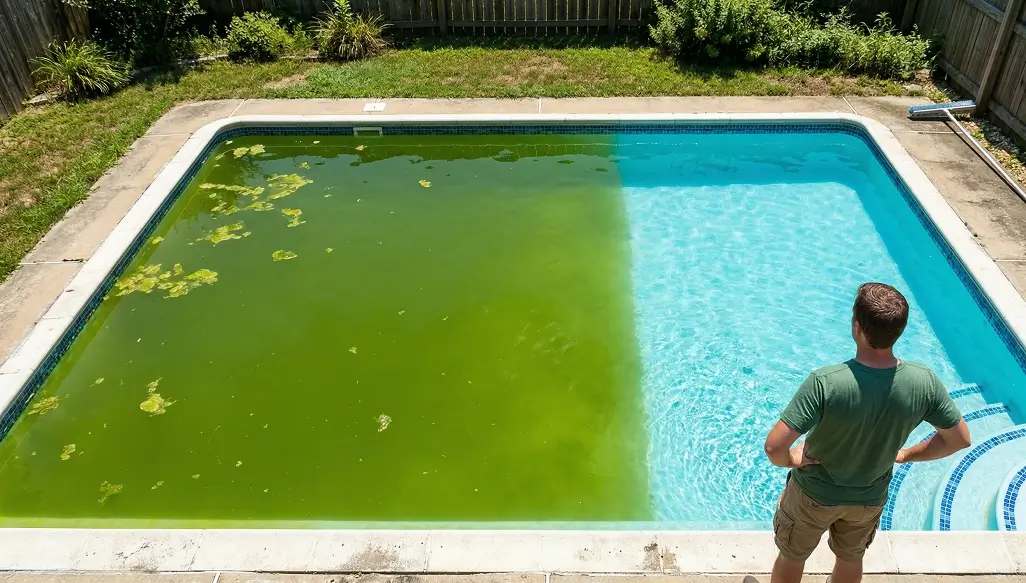
NO. If you’re asking if you can swim in a green pool, the answer is an absolute no—even if it’s blazing hot out and you had a party planned.
I know that is a massive gut-punch. A green pool can ruin a weekend in about ten seconds. But the health and physical safety risks are never worth a single afternoon in the water.
A green pool usually means your sanitizer has dropped to zero (or is completely overwhelmed). When that happens, your pool stops acting like a treated body of water and starts acting like a petri dish. Fortunately, a green pool is fixable if you follow the right order of operations. Here is exactly why you need to keep everyone out of the water, and how you can fix it fast.
Why You Should Never Swim in a Green Pool (The 3 Hidden Dangers)
A green pool isn’t just “a little algae.” It’s a giant red flag that your water is no longer being chemically controlled. When that control slips, the risks go up instantly.
1. A Breeding Ground for Bacteria and Pathogens
Algae itself isn’t the main danger—the bigger issue is what the algae proves. It proves your pool’s sanitizer is failing.
According to CDC guidance, when chlorine and pH are kept in the right range, chlorine can kill E. coli in less than one minute. When your pool is green, you are completely out of that “quick kill” zone. Swimming in untreated water exposes you to the exact real-world problems the CDC warns about: severe swimmer’s ear, skin rashes, and gastrointestinal illness if the water is swallowed.
2. Severe Visibility Hazards (The Drowning Risk)
Green water is cloudy water, which is an immediate, life-threatening safety issue.
Public pool safety codes don’t treat visibility as optional. The CDC’s Model Aquatic Health Code (MAHC) requires that the main drain at the deepest point of the pool be clearly visible from the deck. If you can’t clearly see the bottom, you cannot quickly spot a child or adult in trouble.
3. Dangerously Slippery Surfaces
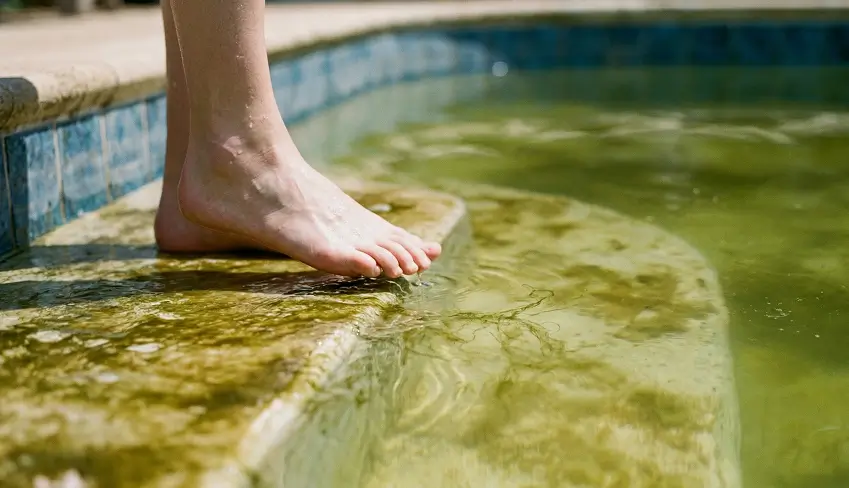
Algae doesn’t just float; it coats. When algae starts growing on your steps, benches, and walls, it leaves a slick, invisible film. This makes your footing incredibly unreliable, dramatically raising the risk of severe slip-and-fall injuries on entry steps.
How to Clear Up a Green Pool Fast (The Step-by-Step Recovery)
Once a pool turns green, speed comes from doing the right things in the exact right order. If you shock the water first but leave a bunch of leaves at the bottom, you will waste your chlorine.
Here is the recovery plan pool pros rely on to turn a pool from green to clear.
Step 1: Remove Organic Debris to Starve the Algae
Leaves, pollen, and bugs don’t just look bad; they actively consume your chlorine and feed the algae bloom.
- Aggressively skim the surface and empty your skimmer baskets.
- Use a heavy-duty leaf net to scoop piles of debris off the floor and out of corners.
To prevent losing hours to manual skimming, a device like the Aiper Surfer S2 Cordless Robotic Pool Skimmer can be incredibly helpful. Because it is a solar-powered robotic skimmer, it can operate 24/7 to continuously pull floating organic debris out of the water while you focus on fixing the chemistry.
Step 2: Balance the pH and Quadruple Shock the Water
Chlorine works significantly better when your pH is balanced. When pH rises too high, your chlorine becomes sluggish and ineffective.
- Test and Balance: Adjust your pH down toward 7.2 before adding any heavy chemical treatments.
- Shock Hard: Hit the pool with a massive dose of liquid chlorine to overwhelm the algae bloom. This often means using 3 to 4 times your normal shock dose, especially if your Cyanuric Acid (CYA/Stabilizer) levels are high.
Step 3: Aggressively Scrub the Walls and Floor
Algae forms a protective slime layer that shields it from chlorine. You must physically break that barrier so the shock treatment can reach the spores underneath.
- Scrub everywhere: Hit the steps, benches, corners, and the waterline ring (which traps oils that algae clings to).
When your pool is in full rescue mode, a high-powered Aiper Scuba X1 Pro Max Cordless Robotic Pool Cleaner can save you a tremendous amount of manual labor. It is designed to aggressively scrub the floors, walls, and waterline, breaking up that stubborn algae film while the chlorine does the heavy chemical lifting.
Step 4: Run the Filter 24/7 and Backwash Frequently
When the algae dies, your pool will flip from green to a cloudy, milky white/gray. This means you are winning! Now, your filter has to physically remove all that microscopic dead material.
- Run your pump and filter nonstop until the water is completely clear.
- Backwash or clean your filter frequently as the pressure gauge climbs (usually 8–10 PSI above your clean baseline).
Conclusion: Patience Is Your Best Chemical
A green pool feels like a disaster, but it is a highly fixable one. In most backyards, a focused recovery push will turn green water clear in about 2 to 4 days.
Let the process work: remove the debris, correct the pH, shock the water, scrub the slime, and filter relentlessly. Do not rush the payoff. Wait until the water is crystal clear and your chlorine levels have dropped back down to a safe 1–4 ppm range before letting anyone jump back in.
Frequently Asked Questions About Green Pools
What are the first signs of algae in a pool?
Most pools don’t go neon green all at once. Early warning signs include water that looks slightly dull or cloudy, a sudden, unexplained drop in your free chlorine levels, and pool steps or walls that feel slick or slimy to the touch.
What causes a pool to turn green overnight?
A pool turns green overnight due to a perfect storm of chlorine loss and algae opportunity. Heavy rainstorms can wash nitrogen and phosphates into the water while diluting your chemistry. Alternatively, if your Cyanuric Acid (CYA) is too low, a hot, sunny day can burn off all your protective chlorine in a matter of hours, allowing an algae bloom to take over immediately.