
How Often to Water New Shrubs (And Avoid Root Rot)
New shrubs need a gradual watering schedule in their first year: frequent light watering initially, then deep, less frequent watering to avoid root rot. Use mulch to retain moisture and choose a zoned smart irrigation system to meet the different needs of lawns and shrubs.

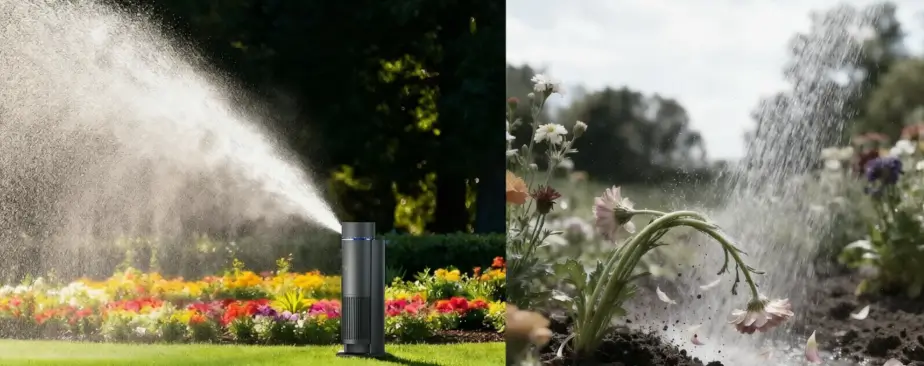
Transforming your garden with fresh landscaping is one of the most satisfying weekend projects a homeowner can undertake. There is nothing quite like stepping back to admire a newly planted row of vibrant boxwoods, hydrangeas, or native azaleas. But fast forward a few weeks, and that initial triumph often turns into a frantic guessing game. The leaves are drooping, the edges are turning brown, and you are left wondering: how often to water new shrubs without accidentally drowning them?
If you have ever lost a newly planted shrub despite feeling like you were constantly holding a hose over it, you are not alone. Watering new plants is the most critical factor in their survival, yet figuring out exactly how much water do new shrubs need is also the easiest thing to get wrong.
In this comprehensive guide, we are going to dive into the exact watering timeline for new additions to your garden. More importantly, we will explore the often-overlooked concept of plant-specific irrigation: watering grass vs. shrubs, and how modern garden techniques and smart home technology can take the guesswork out of your yard's survival entirely.
Why Watering New Shrubs is Fundamentally Different
To understand how to care for watering newly planted shrubs, you first need to understand what the plant is experiencing. When you bring a shrub home from the nursery, its root system is confined to the exact shape and size of its plastic pot. It has spent its entire life being pampered in a highly controlled environment.
When you plant it in the ground, the shrub enters what botanists call the "establishment phase." The plant's primary goal isn't to grow taller or produce flowers; its absolute priority is to push its roots out into the surrounding soil to secure a permanent water source.
During this vulnerable phase, the shrub cannot access moisture sitting just a few inches outside its original root ball. If that specific, confined area dries out, the plant suffers immediately. However, if the soil is constantly waterlogged, the roots are starved of oxygen and will quickly succumb to root rot. You are walking a tightrope between dehydration and suffocation.
The Exact Timeline: New Shrub Watering Schedule
The golden rule of garden maintenance is that deep, infrequent watering is vastly superior to shallow, frequent watering. You want to train the roots to dive deep into the earth. However, new shrubs need to be eased into this routine.
Here is a general guideline for your new shrub watering schedule during the critical first year. Please note: These guidelines should be adjusted based on your local climate (such as the arid heat of Arizona versus the frequent rainfall in the Pacific Northwest), sun exposure, and soil type.
Week 1 to Week 2: The Critical Window
During the first two weeks, your new shrub is in a state of shock. You need to keep the root ball and the immediately surrounding soil consistently moist, but not muddy.
- Frequency: Water every 1 to 2 days, depending on the weather. If you are planting during a sweltering summer, daily watering is usually necessary.
- Method: Apply water directly to the base of the plant slowly, allowing it to soak deep into the root zone.
Week 3 to Week 12: Encouraging Independence
By now, the roots have tentatively begun to explore their new home. You can start easing off the frequency to encourage those roots to search deeper for moisture.
- Frequency: Reduce watering to 2 to 3 times a week.
- Method: Increase the volume of water slightly, but apply it less often. Check the soil moisture before watering. Dig your finger about 2 inches into the soil near the base; if it feels dry, it is time to water. If it is still damp, hold off for another day.
Month 4 to Month 12: Building Resilience
As the seasons change, your shrub is becoming established.
- Frequency: Once a week should suffice, unless you are experiencing a prolonged dry spell or a blistering heatwave.
- Method: Deep, slow watering is essential. You want the moisture to penetrate to the depth of the root zone—typically around 12 inches, though this may vary by plant size—to support a deep, robust root structure that can withstand future droughts.
Note on Soil Types: Always factor in your soil's composition. Understanding the differences between clay vs. sandy soil is crucial for your watering schedule. Sandy coastal soils drain incredibly quickly and may require more frequent watering. Heavy clay soils hold moisture for a long time and are highly prone to waterlogging, requiring a much lighter touch.
The Secret Weapon: Mulch
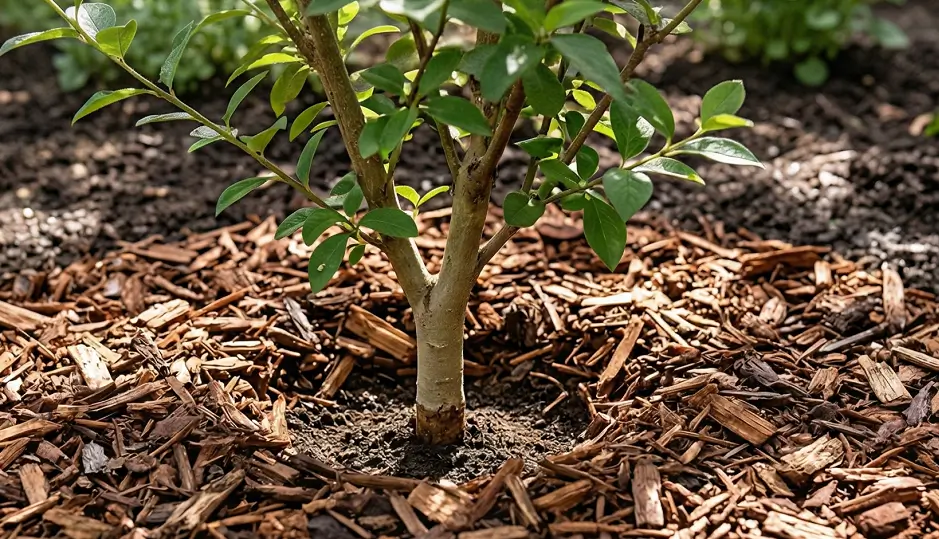
One of the most effective ways to protect your new investment is mulching. Applying a 2 to 3-inch layer of organic mulch around the base of new shrubs can significantly improve moisture retention in the soil, regulate temperature extremes, and reduce your overall watering frequency. Just ensure the mulch is pulled slightly back from the main stem to prevent rotting.
Common Mistakes When Watering Newly Planted Shrubs
Even with a schedule, it is easy to make well-intentioned errors. Watch out for these common pitfalls:
- Overwatering: More plants die from drowning than from drought. Constantly soggy soil suffocates roots and breeds fungal diseases like root rot.
- Watering Leaves Instead of Roots: Spraying the foliage might look refreshing, but it encourages leaf fungus and wastes water to evaporation. Always water the soil directly at the base of the plant.
- Inconsistent Schedules: Letting a plant bone-dry out and then flooding it creates severe stress. Consistency is key during the establishment phase.
The Garden's Biggest Conflict: Plant-Specific Irrigation (Watering Grass vs. Shrubs)
Here is where the traditional American backyard setup often falls apart. You have meticulously followed the timeline above, yet your shrubs are still struggling, while your lawn is looking suspiciously swampy. The culprit? Your sprinkler system.
The most common landscaping mistake is treating your entire yard as a single, uniform organism. This brings us to the crucial concept of plant-specific irrigation: watering grass vs. shrubs.
Biologically, turf grasses and woody shrubs have opposing survival strategies:
- The Grass Profile: Lawn grasses have highly dense, very shallow root systems—usually sitting just 2 to 6 inches below the surface. They thrive on relatively high-frequency, shallow watering to keep the top layer of soil hydrated.
- The Shrub Profile: Shrubs have expansive, deep-diving root systems that can easily reach 12 to 20 inches underground. They require low-frequency, deep-penetrating watering.
When you use a standard, traditional sprinkler system to water your entire yard on the same schedule, you are forced into a terrible compromise. If you run the sprinklers long enough to deep-water the shrubs, you flood the lawn. If you run the sprinklers on a short cycle suited for the grass, the water never penetrates deep enough for the shrubs.
In most cases, you cannot successfully water both with a "one size fits all" approach. You need a method that understands the difference.
A Practical Solution: Smart and Zoned Irrigation
To address this challenge, many homeowners turn to dedicated manual solutions like hand-watering different zones, laying down separate drip irrigation kits, or weaving soaker hoses through shrub beds. While these traditional methods are highly effective for plant-specific irrigation, they can be time-consuming to manage and adjust as the weather changes.
For those looking to automate their yard care without sacrificing plant health, zoned or smart irrigation systems offer a practical solution.
An excellent example of this modern approach is the Aiper IrriSense 2, a 4-in-1 multi-zone smart irrigation system. Designed to simplify plant-specific watering, it helps homeowners achieve lush lawns and healthy shrubs with significantly less effort and water waste. Here is how modern smart systems address common landscaping challenges:
1. Customizable Plant-Specific Zoning
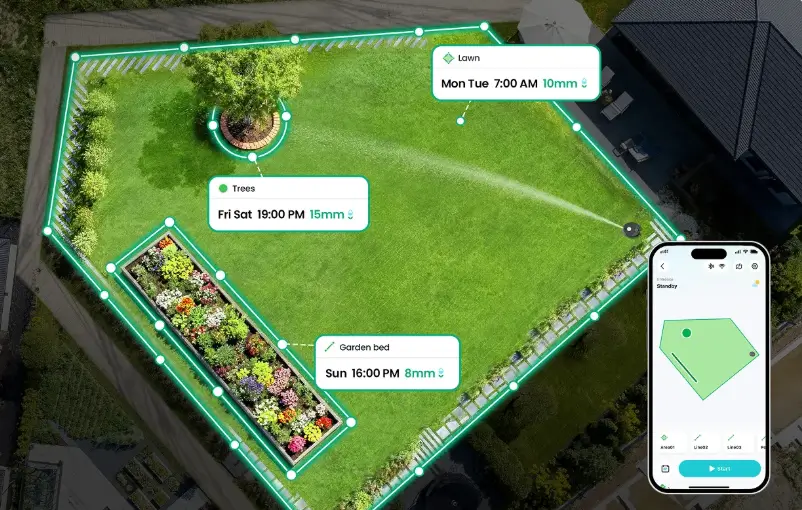
The key to healthy gardens is mapping. Through smart app controls, systems like the IrriSense 2 allow you to carve your garden into distinct, customizable watering zones. You can set Zone A (your lawn) to receive a light, even spray mimicking natural rainfall a few times a week, while simultaneously programming Zone B (your shrubs) to receive a targeted, slow, and deep watering just once a week.
2. Weather Adaptation & Soil Health
There is nothing worse than your automated sprinkler turning on during an autumn downpour. Integrated weather-response systems actively monitor local forecasts and automatically pause watering schedules if rain is imminent, ensuring delicate new shrubs never drown.
Additionally, some advanced systems feature nutrient dispensing. For the US market, the IrriSense 2 is compatible with Aiper's upcoming Soil Pulse™ Microbial Organic Soil Amendment. This allows you to distribute organic microbial formulas evenly through the water flow to enhance soil fertility, improve water retention, and nourish the soil exactly when new plants need a boost.
3. Simplified Installation
Upgrading your irrigation used to mean tearing up the yard. Today's smart controllers often feature modular, tool-free designs that allow you to easily install a sprinkler system without digging any trenches, integrating the controller, valve, and feeders into one unit for a quick 15-minute DIY setup.
Conclusion: Smarter Watering, Lusher Results
Figuring out how often to water new shrubs doesn't have to be a source of stress. By understanding the critical establishment phase, adhering to a climate-adjusted watering timeline, and utilizing protective measures like mulch, you are already well on your way to a thriving landscape.
The days of guessing if the water has penetrated deeply enough can be put behind you. Whether you choose to implement targeted soaker hoses or upgrade to an automated, multi-zone solution like the Aiper IrriSense 2, respecting the differences between your grass and your shrubs is a practical way to actively nurture your plants precisely the way nature intended.