
How to Get Rid of White Flakes in Pool Quickly (Identify & Fix)
Identify white pool flakes in 60 seconds: fizzing in vinegar means calcium scale; slimy texture indicates water mold. Treat scale by lowering alkalinity and mold with shocking.

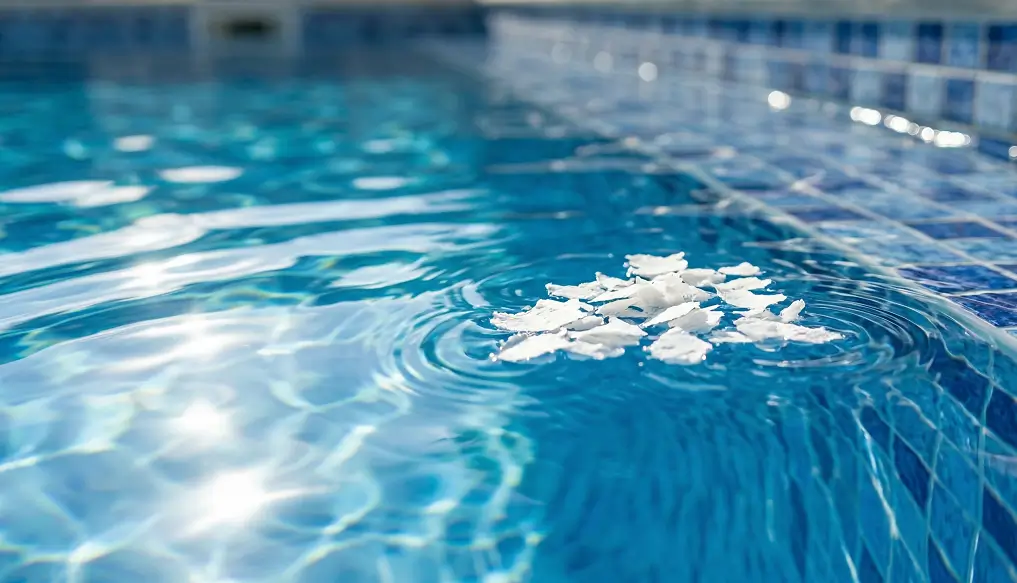
White flakes floating in your water or settling on the floor can look alarming. Fortunately, they usually aren't your pool surface "peeling," and your plumbing isn't falling apart.
To get rid of white flakes quickly, you must first stop guessing and identify what they are. Treating mineral scale with organic chemicals—or vice versa—will only waste your time and money. Here is the fastest way to diagnose and clear your pool.
Stop Guessing: The 60-Second Flake Identification Test
Most white flakes fall into one of two categories: mineral scale (calcium) or organic growth (white water mold/biofilm). You can figure out exactly what you are dealing with using two quick, hands-on tests.
The Vinegar Test (Identifies Calcium Carbonate Scale)
Calcium scale is essentially a soft rock made from calcium carbonate, and the flakes often look exactly like crushed white eggshells. In basic chemistry, carbonates react with acids by releasing carbon dioxide gas.
For the chemistry buffs, the reaction looks like this:
Calcium scale is essentially a soft rock made from calcium carbonate. In basic chemistry, carbonates react with acids by releasing carbon dioxide gas.
- Scoop a small pinch of the flakes into a clear cup.
- Add enough plain white vinegar to cover them.
- Watch closely.
The Result: If the flakes fizz and start dissolving, you are dealing with calcium carbonate scale. (If you have a saltwater pool, this scale is likely forming inside your salt cell, breaking loose, and blowing into the pool).
The "Squish" Test (Identifies White Water Mold)
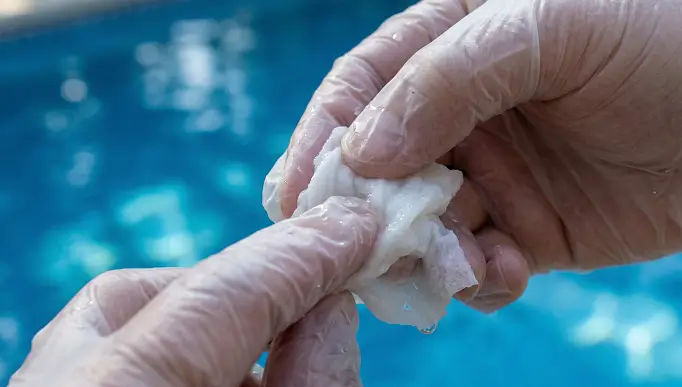
If the vinegar test does nothing, the flakes are not mineral-based. White water mold often looks like shredded tissue paper or whitish, mucus-like bits.
- Scoop a small amount into a gloved hand.
- Press it gently between your fingers.
The Result: If it smears, squishes, feels slimy, and doesn't react to vinegar, treat it as an organic biofilm. Biofilms act as a protective layer that makes germs harder to kill with chlorine alone, requiring a different cleanup strategy.
How to Get Rid of Calcium Flakes (Saltwater Pools)
If your flakes fizzed in vinegar, they are calcium carbonate. In saltwater pools, the salt cell’s electrolysis creates high heat and high pH, causing scale to form on the metal plates. When the cell reverses polarity to self-clean, it fractures this scale, blowing it into your pool.
Here is how to stop the cycle:
1. Lower Your Total Alkalinity (The Root Cause)
Total Alkalinity (TA) is your pool’s pH buffer. When TA is high, your pH constantly pulls upward, which is a massive driver of calcium scale.
- Use muriatic acid to safely lower your TA.
- A practical target for salt pools is 60–80 ppm TA. Lowering your alkalinity lowers your "pH ceiling," making it much harder for scale to form inside the cell.
2. Add a Pool Scale Inhibitor
If you live in an area with hard water, a scale and metal inhibitor will bind to the calcium in your water, keeping it in solution so it cannot crystalize and turn into flakes.
3. Turn Down Your Salt Cell Output & Increase Cycle Time
Running a salt cell at 100% output creates excessive heat and rapid scaling inside the chamber. Turn your cell output down to 70% or 80%. To ensure your pool still generates the total amount of daily chlorine it needs to stay sanitary, increase your pump's cycle time to compensate for the lower output setting.
4. Use a Clarifier to Settle Suspended Particles
Before you try to vacuum, you need to deal with the microscopic calcium dust floating in the water. Add a high-quality pool clarifier. This chemical acts as a coagulant, forcing those tiny, suspended white particles to clump together and drop to the pool floor so they can actually be vacuumed up.
5. Continuously Vacuum the Floor Sediment
Once calcium flakes break free, they tumble around and sink, eventually looking like coarse white sand on your pool floor. You must remove them so they don't grind into your pool surface.
A device like the Aiper Scuba V3 is incredibly helpful during this cleanup phase. Because it is a powerful cordless robotic pool cleaner with dual brushes, it can actively scrub and vacuum this heavy, abrasive calcium sediment off the floor and out of corners while you focus on balancing the water chemistry.
How to Get Rid of White Water Mold (All Pools)
If your flakes felt squishy and slimy, you are dealing with white water mold. This is a living, sticky biofilm that clings to surfaces, hides in your plumbing, and rapidly consumes your chlorine.
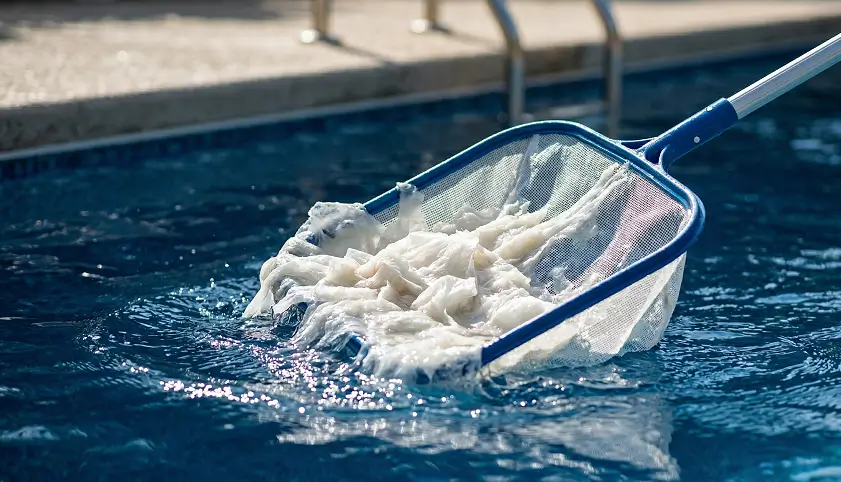
1. Aggressively Skim the Surface
White water mold often starts as floating clumps. The fastest way to reduce the strain on your chlorine is to physically remove as much of this organic matter from the surface as possible.
If you want this surface cleanup handled continuously without standing outside with a net, a solar-powered robotic pool skimmer like the Aiper Surfer S2 is built specifically for this job. It operates 24/7 to capture floating organic debris before it can sink and cling to the walls.
2. Brush the Entire Pool and Quadruple Shock
Chlorine cannot easily penetrate biofilm's protective slime layer. You must break it manually.
- Brush everything: Walls, floors, steps, and especially behind ladders or in "dead zones" with poor circulation.
- Shock immediately: Hit the pool with a massive dose of liquid chlorine (often 3 to 4 times the normal shock dose).
- Wait: Do not swim until chlorine and pH levels return to safe, normal ranges (pH 7.0–7.8 and chlorine 1–4 ppm).
3. Chemically Clean Your Filter
If you skip this step, the mold will come back. Biofilms hide inside filter media and will continuously blow back into the pool. Backwash your system, then perform a deep chemical soak using a dedicated filter cleaner to eradicate the hidden spores.
Frequently Asked Questions
Is it safe to swim in a pool with calcium flakes?
Yes. Calcium flakes are simply calcium carbonate. While they might feel scratchy or gritty on your feet, they are not toxic or dangerous to swimmers. Just ensure your standard chemistry (pH and chlorine) is balanced.
What causes white sediment in a pool?
White sediment on the pool floor is usually one of two things: calcium flakes that have tumbled around and ground down into gritty "sand," or dead organic material (like algae or water mold) that has dropped out of suspension after a shock treatment.
Conclusion
White flakes look dramatic. But the fix is usually simple once you name the culprit.
If the flakes fizz in vinegar, treat them like calcium scale. Balance your water (especially pH and total alkalinity in salt pools), and keep your LSI/CSI in a “balanced” zone so the water is less likely to form scale in the first place. Many industry references define “balanced” as roughly −0.3 to +0.3 LSI.
If the flakes don’t fizz and feel slimy or tissue-like, treat them like white water mold / biofilm. That means physical removal (skim, brush, filter-clean) plus strong sanitation—not just “more chlorine once.” (Biofilm-embedded microbes can need far more disinfectant dose/contact time than free-floating ones.)
You can explore Aiper cordless robotic pool cleaners and more.